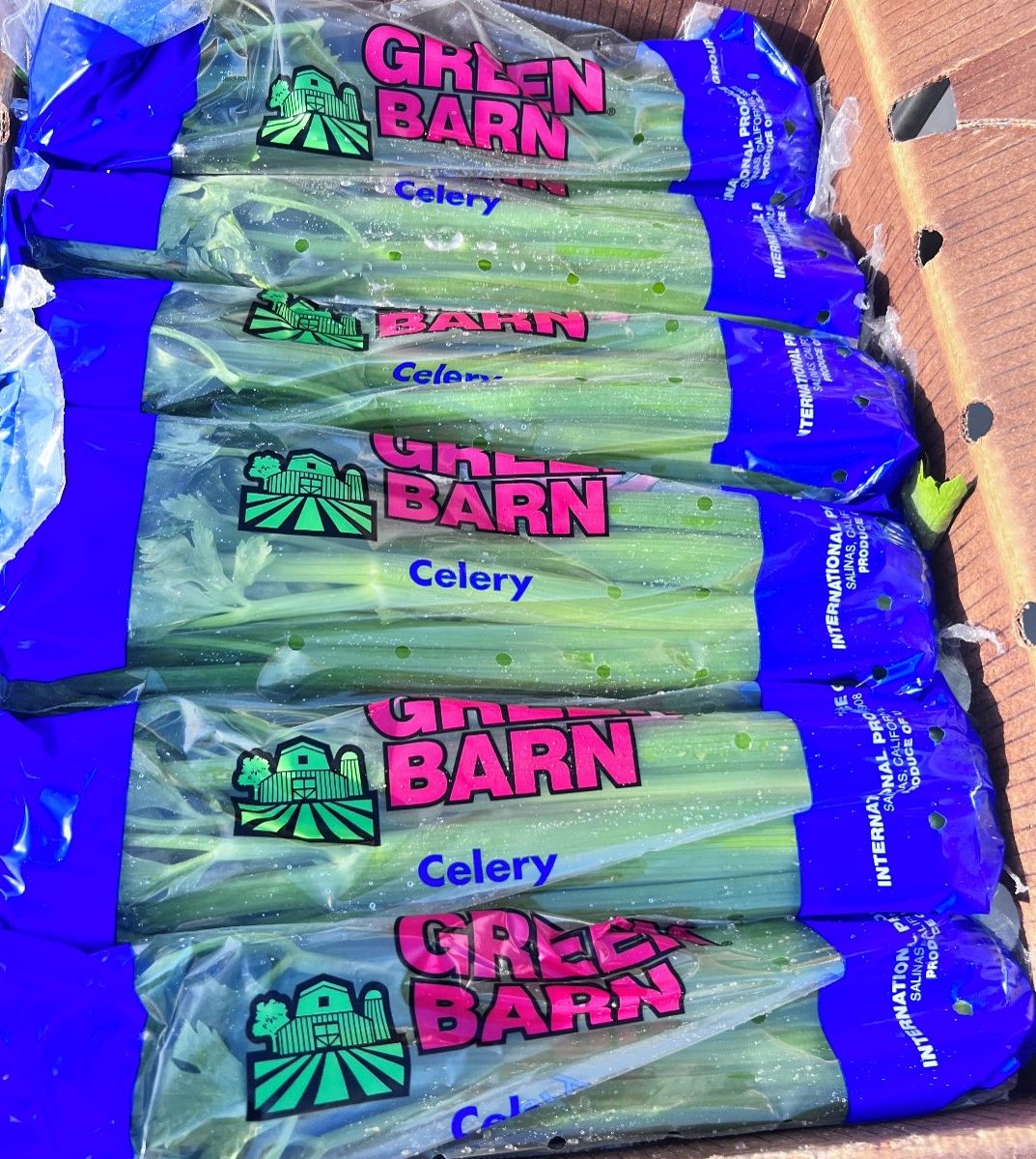
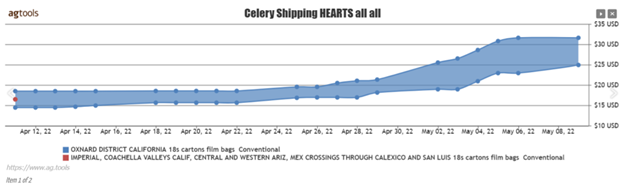
California Celery Light Supplies, High Market

Celery prices have about doubled in the past few weeks as the crop transition has led to light supplies. California celery supplies have decreased substantially in Oxnard and Santa Maria, California, and the Florida season has ended.

Yields in Oxnard and Santa Maria fields were impacted by heavy rains in January, and by seeder ranging five to seven inches following two heat spikes in March/April.

Elevated markets are expected to maintain until full transition to Salinas is complete in mid-late June.

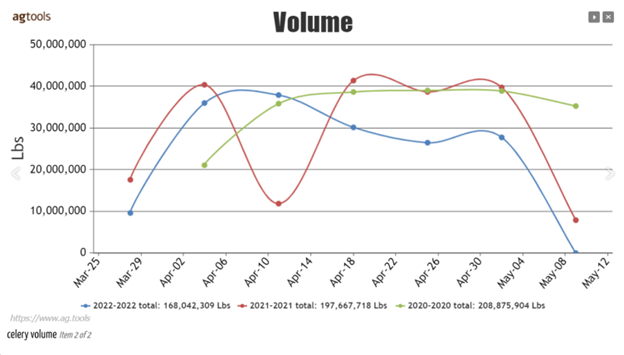
Agtools reports Southern California volume is 39 percent below last year so far; Central California volume is off 14 percent and imports from Mexico are 27 percent lower than last year.


Northwest Cherries Estimate 150,000 Tons In Round One Crop Report

The Northwest Cherry Growers of Yakima, WA, released its round-one estimate of the 2022 cherry crop –– estimating 150,000 tons of cherries or 15 million 20-pound boxes for the season. This initial report had been pushed back a week due to the unusually cool spring temperatures felt across the Northwest.

“How many times have we started off this annual email with some variation on the phrase, ‘every cherry season will be unique,’” said B.J. Thurlby, president of Northwest Cherries. 2022 certainly looks to be just that — highly unusual –– as April brought snowfall to cherry blossoms and suspended blooms due to persistently cold temperatures.

Even with the atypical report, Thurlby said, “cherries in the earliest districts, namely those that had already gone through bloom by the time the first snow arrived appear to be doing well.” The early-season crop is reportedly developing beautifully but slowly. Thurlby conferred confidence in Northwest growers: “When the weather isn’t exceptional, growers are well equipped to keep at least most of their crops safe through the spring storms” –– noting they are a resilient and persistent group.

“Perhaps the oddest thing about the 2021 bloom is the period of suspended animation that occurred,” said Thurlby. While the snow caused damage to most of the open flowers, unopened buds in growing regions removed from the extreme cold appear to have waited until temperatures warmed before continuing their bloom. “This helped some flowers survive but created time gaps of up to a week or more within individual trees and/or orchards,” said Thurlby.

Northwest Cherry Growers reports one of the biggest challenges in the immediate future is the need for an extended period of warm weather to activate bee activity and pollination. Thurlby said, “Unfortunately, the periods of warmth and sunshine across much of the Northwest have been shuffled in with storm fronts and cool periods.” He explained that these inconsistent windows of temperature have allowed bees to jumpstart some orchards or limited the pollinator’s ability to find viable cherry blooms to pollinate. “These two factors alone have made the estimation process particularly data-intensive this year as we attempt to draw an accurate bead on the crop to come,” said Thurlby.

Ideal weather pre-season had the Northwest on track for an early kickoff. The April anomaly, however, will transform the season with some districts starting early and others finishing late. Thurlby said, “this bodes well for both early- and late-season cherry supplies for the shelves.”

Northwest Cherry Growers reports the earliest growers are expecting to begin harvest on May 28 into the first week of June. Thurlby said, “as always, it takes our industry at least 10 days to begin to build up to larger volumes,” and noted this early-season volume should allow cherry-focused retailers to transition smoothly from the California crop.

Regarding volume throughout the season, Thurlby said, “our harvest progression is an echo of our bloom, which makes the size of the middle portion of our crop today’s biggest question mark.” Northwest Cherry Growers said this year’s Bing crop was the hardest hit, along with orchards within local cold pockets.

Thurlby noted caution with charting an early projection from the round one data and cited the 2012-14 seasons where crop curvature showed a larger second peak coming from the later varieties and districts. Thurlby said, “We expect to see the daily shipment volumes increase and finish out July with a stronger second half.”

“Though not as large as some recent seasons, the 2022 crop is still a promotable cherry crop and too valuable to be re-allocated to a hidden away display,” said Thurlby. Citing a 2009 Northwest Cherry Growers study, Thurlby said, “that even in recessionary times, fresh sweet cherries from the Northwest were the No. 1 dollar-per-square-foot item in the summer produce department.”

While acknowledging the unusually cold spring season and current economic stress on American consumers, Thurlby affirmed the position of Northwest cherries in summer grocery produce departments. He said, “Cherries are a stalwart of summer displays and over-perform for their space, doubling what grapes produced in an audit of departments across the U.S. last season.”

Cherries are statistically an impulse item, where “nearly three out of every four bags sold is purchased individually from a brick-and-mortar store shelf,” said Thurlby. Even in a down or shortened season retailers need to be ready. “Online shoppers are a full one-third more likely to buy two bags of cherries at a time, and are 400 percent more likely to buy three or more bags.”

Even if round one went to Mother Nature, Northwest Cherry Growers is optimistic about the length of the season and how it will progress. Thurlby concluded, “as of today, there appear to remain promotable opportunities for what should be a crop of dessert-quality fruit.”

From The Produce News

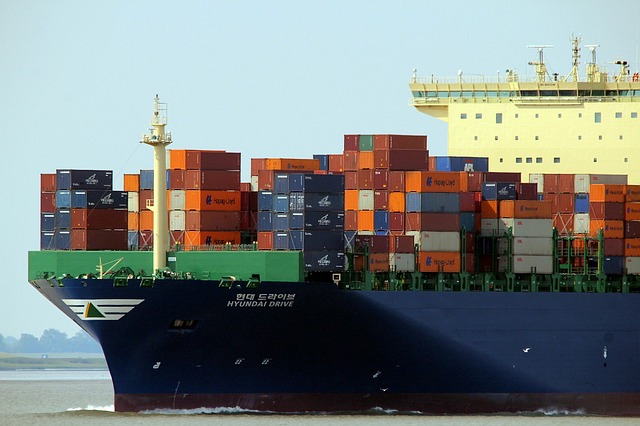
Maersk Warns Of Slowdown On The Horizon

Danish shipping group AP Møller-Maersk anticipates “a slowdown in the second half, a normalization”, according to its chief executive Søren Skou, The Financial Times reports. This comes despite the highest profits of $19.3 billion (+55 percent) made in its 114-year history, in the first quarter.

“The visibility is quite low. Mainly we see risks building up in the economy, in China with the Covid-19 policy, where they use these very hard lockdowns, some downgrades due to a very high oil price,” he told the publication.

The leader in global trade lowered its growth forecast to a possible small decline, but upgraded its underlying operating profit forecast for this year from $19 billion (February 2022 estimate) to $24 billion. 

Skou explained this estimation as a result of a “sharp decline” in freight rates in the second quarter, in contrast to record high prices and demand cited last year, meaning “we have quite some ability to weather a bit of a storm”. 

The executive also countered critics who have questioned the shipping industry’s earnings, saying that regulators around the globe had investigated the container shipping industry, but found high profits were due to supply and demand dynamics. He expects more such probes in the future.

He mentioned that, although “too early to tell”, some economists expect a possible recession in the U.S. at the end of this year. “We clearly see inflation, and I don’t think it’s temporary”. 

Declines in both Chinese export orders and trust in European and U.S. consumers and businesses “suggest we will see less growth […] into next year”, he said. 

Skou added, “what everyone fears is that you get a big spread of Omicron that forces China to shut factories. We don’t see it yet.”

Maersk also lost $718 million after Russia’s invasion of Ukraine, as it was forced to abandon 20,000 containers in Russia and exit logistics and port terminals last month.

From FreshFruitPortal

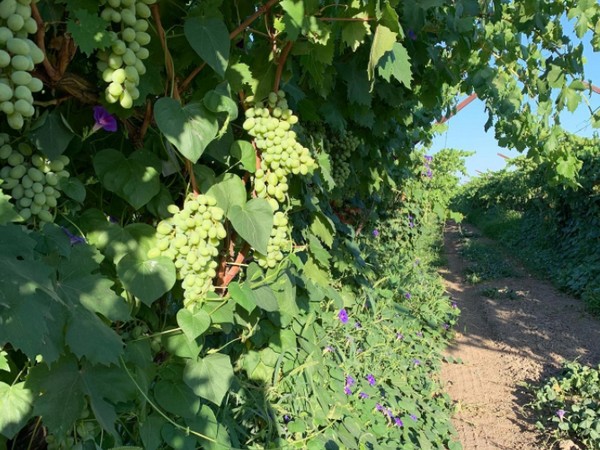
Coachella Continues The Transition To New Grape Varieties

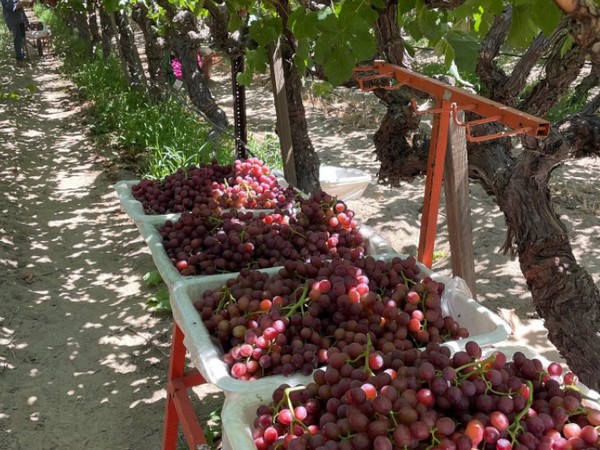
The early part of the California grape season is about 10-15 days away from starting.

Rob Spinelli of Anthony Vineyards in Bakersfield, California says production will begin in Coachella about a week earlier than normal–it’s set to begin the week of May 16. He also notes that generally production out of Coachella has been dropping over the past few years largely due to costs and pricing. The Coachella window of production competes directly with Mexican grape production and with increasing labor and other costs in the region, many growers there have diverted their land to other crops.

“However we’re actually a little higher in volume than last year because we have new plantings coming into production. Our other plantings are more mature so we’re going to have overall higher volumes,” he says. Anthony Vineyards has been progressively changing varieties in the desert region to meet retailers’ interest in better varieties that are more flavorful and have better yields rather than the traditional Flame or Sugraone grapes. Instead, in that region Anthony Vineyards is producing grapes such as Candy Snaps, a high-flavor red grape and on green grapes, its Sweet Globe and Autumn Crisp. Other, yet unnamed varieties are also coming down the road and Anthony Vineyards is generally working on rounding out is organic production and incorporating newer varieties of grapes.

The interest in local
Spinelli anticipates the crop will meet good demand, particularly from those interested in local grapes. “Especially where the field farm workers are shopping–they want to see their work and there’s pride in the work they’re doing in the desert,” he says.

As for pricing, Spinelli is hoping for stronger pricing this year. “We want a higher price due to the inflation we’re experiencing as growers. We would like to see some higher FOBs,” he says. “If we do last year’s pricing, that’s going to be hard to meet given how much our biggest cost, labor, has gone up as well as materials.”

Looking ahead at the bulk of the California crop, it will begin in July out of San Joaquin. “The crop size was up and it looked like there was going to be a big crop. But then a couple of weeks ago, we had a bit of a freeze that hit growers throughout the whole valley,” says Spinelli. “That’s going to take some of that crop out of production and they’re now estimating 98 million boxes out of California after the freeze.”

From FreshPlaza

GLOBAL OVERVIEW KIWIFRUIT

It’s all go in the world of kiwis, as the European season makes way for the New Zealand season, with Zespri at the forefront. The demand for kiwis on many market continues to grow, including in France, where a new French kiwi grower organisation has been set up to benefit from this continued increase in consumption. South Africa also aims to significantly increase it’s domestic production. Although somewhat improved, logistical issues remain an issue for this fruit, which relies on import to many market, causing a back up of European production on both the North and South American markets.

Netherlands: Zespri kiwi season starts
This period always guarantees the start of the kiwi season. At the end of April, the first charter boat with Zespri SunGold kiwis arrived in Zeebrugge. “There is a continuing demand for Zespri kiwis on our European market,” Zespri announced. The kiwi giant expects a supply of more than 64 million Zespri kiwi shells (SunGold and Green) on the European market this year.

France: New French kiwi grower organisation aims to increase production
The French kiwifruit campaign is coming to an end. The last volumes should be sold by the end of May, while the New Zealand origin is gradually taking place on the shelves of supermarkets and wholesalers. The end of the season is later than last year despite a slightly lower production due to the aging of the orchards, more than 15,000 tonnes over the last 5 years. This is an issue, as the consumption of kiwis in France is rising, and the reduction in domestic production means it is the importers that are profiting from this, rather than local producers. The French are more and more sensitive to a segmented offer of kiwis (organic, Label Rouge etc.), guaranteeing quality, a production that has been well valued this year. 

The recent creation of the AOPn Kiwi de France, an organisation of French kiwi growers, has among its objectives to support the French kiwifruit production and to help the renewal of orchards in order to meet a French demand that is currently higher than the supply.

South Africa: South African kiwi production on the rise
South Africa is not self-sufficient in kiwis – yet: there is big interest in kiwi fruit (green, yellow and red-fleshed) and considerable expansion to not only supply the domestic market, but also for exports because there is an excellent export window to the Northern Hemisphere for South African growers before the New Zealand season starts.

In three or four years, it is expected that local kiwi volumes will be much higher than today.

The domestic season of Hayward (green) kiwi volumes started in February but volumes on the municipal have been very low, a trader says. The price for a 10kg carton of Hayward kiwis is approximately R500 (30 euros) at the Johannesburg municipal market. Prepacked kiwis are selling faster than loose kiwis.

Currently, though, kiwis are imported year-round from New Zealand (starting round about now) for 6 months, and Italy & Greece for the other six months. Imported kiwis for other destinations in Africa, like Kenya, are flown out from South Africa. Demand for imported green and gold kiwis from the retail sector is good, and it helps that the hospitality sector is slowly rebounding after Covid.

Domestic consumers aren’t very familiar with gold kiwis yet (they are sold in very small quantities at the municipal markets) but there is strong growth in gold kiwi retail sales every year.

China: Lockdowns affect imports, but high hopes for domestic kiwi season
At the moment, there is no domestic kiwifruit on the Chinese market. Kiwi season will start in October, kiwi berries will be on the market from July. Sichuan, Shaanxi and Yunnan are key regions for kiwifruit production. This season, few plants have been cut because growers believe in a profitable market for the 2022-2023 season. So far, quality of the kiwifruit seems to be good. Kiwi berry is a fast growing product category in China. Market prices are high, but there is limited supply so it’s market availability is short.

China is the largest trade partner for New Zealand agricultural exports and an important market for its Zespri kiwifruit. The Zespri brand is the largest brand in China, with 80% market share, and very much liked by Chinese consumers. The first shipment of kiwifruit from New Zealand arrived in Zheijiang on April 10.

Chilean kiwifruit is also in season. However, currently, Shanghai is in lockdown and its fruit import markets are closed or temporarily closed. A consequence is that Chilean fruits have difficulties being sold in and near Shanghai.

North America: Logistical issues cause back up of European fruit on market
Kiwi supplies in North America are still transitioning out of mostly European fruit.

“There’s still mostly Italian fruit available still because there were a lot of logistics problems getting the product into the U.S. So, it’s in clean up mode there,” says one California-based importer.

At the same time, there is also some California kiwi volume as well and New Zealand kiwis will also start this month.

The fact that there’s still European fruit in the market has in turn slowed down Chile’s kiwi start, although it has been shipping fruit for about a month. “But it’s been more limited volumes to start and a lot of that is driven by importers saying–hey, don’t send it right now because there’s clean up from the Northern hemisphere,” says the shipper.

Overall, he notes that the Chilean crop size is similar to slightly greater than last year’s crop. “It seems like the sizing is a bit smaller compared to other years and when you have smaller sizes, you generally have less tonnage, though that’s still to be determined,” he says.

Demand and pricing have both been stable. “It’s not a huge promotion item. And for the European and the Chilean fruit, costs are higher due to many inflationary things. But if the market starts backing up and really falling behind, it’s not going to matter what the costs are at some point,” says the importer, adding that pricing is slightly up over last year. “Pricing is similar to slightly higher but under different circumstances than last year at this time. We didn’t have this much leftover fruit from the Northern hemisphere when the Southern hemisphere fruit got going.”

That said, he does note that while logistics are better than they were three to four months ago, they are still more difficult compared to other seasons. “That’s contributing to the back up of European fruit lingering in markets around the world. It’s caused Chile to have a slower start on exports because demand is curtailed because of that,” he adds.

Looking ahead, the transition away from European fruit will continue and demand in the U.S. is anticipated to wane somewhat. “Kiwis move a bit better while school is in session and summer break is coming up pretty quick,” he says. “Demand slows down from mid to late May and through most of the summer. So we see regular business maintaining but we don’t see an uptake in demand.”

South America: High European stocks delay start of the kiwi campaign from the southern hemisphere in Europe
Chile expects to market between 150,000 and 155,000 tons of kiwis in this new campaign; however, the start of the season has been slower than expected, since it has coincided with significant stocks of fruit in the markets in the northern hemisphere.

In fact, up to week 16, the volumes shipped by Chile to the different international markets represented only 62% of those shipped up to the same week of 2021.

“Zespri has been exerting more and more pressure on the markets to place and market its supply of yellow kiwifruit, delaying the sale of its green kiwifruit, which has meant that Europe has had to delay the start of its campaign until mid-December, when normally they should start in November”, explains an industry representative. “Starting later means having less time for marketing in the campaign, which is why Europe is trying to increase overseas shipments to try to balance supply in order to obtain a better return for its producers.”

The contraction in shipments has been driven precisely by the delay in shipments to Europe and the presence of European fruit in the destination markets for Chilean kiwis. According to data up to week 16, North America has been the main destination for Chilean fruit, receiving 35.2% of exported volumes and registering the smallest drop in shipments, only -6%. Latin America is the second most important destination receiving 25.3% of the Chilean kiwis exported (-26%), followed by Europe with 19.3% (and a notable drop of 64%), the Far East with a 14% share (-43%), the Middle East with 5.2% (and leading the only positive year-on-year variation, with +12%) and Russia, where shipments have fallen by 93% to represent a symbolic 0.6 % of the total.

“However, this slower start to the harvest has allowed the Chilean industry to have fruit with better physiological parameters, although with smaller sizes than we would like due to climatic factors.”

Oceania: Positive outlook for kiwi season, despite tough start
Zespri admitted in this week’s industry update that it has been a challenging start, but it is now making real progress. On the shipping front, there are over 45 million trays on the water or in the market, with all the key charter markets now receiving regular deliveries, and the fruit arriving to meet the strong demand. Zespri expects to undertake four charter sailings to North Europe, 12 to the Mediterranean, six to the US West Coast and 50 to Zespri’s Asian markets, and to send around 20,000 containers of kiwifruit this season. 

The first of the season’s SunGold left Tauranga bound for Zeebrugge, Belgium and arrived in late April, with two more arriving in the following 10 days to build a healthy stock level, with the first of the green variety expected in May. The latest estimates show a supply of more than 63 million trays of Zespri Kiwifruit (SunGold and Green) in 2022 across the European markets. 

Japan, Korea and Taiwan have all had really positive starts and are receiving regular shipments and the first Europe vessel. On April 10, the cargo ship STAR SPIRIT loaded with the new season Zespri kiwifruit departed from Tauranga Port and docked at Damaiyu Port, Taizhou, Zhejiang. 

The first charter vessel to the US in a number of years is also due to arrive in Los Angeles next week and will be followed by five more this season. The company also continues to monitor the situation in China closely, as COVID-19 lockdowns continue, meaning fruit continues to be unloaded smoothly, albeit at a slower pace. From a supply chain side, Zespri has secured additional shipping capacity to keep the fruit moving and avoid congested cool stores. The China team are positive about making up the effects of the delays during the season to meet sales targets.

Overall, Zespri has 93 million trays, or about 48 per cent of the estimated crop in submit, which is 10 million trays ahead of the same time last year. The SunGold Kiwifruit mainpack is well underway, with 68 million trays of SunGold Kiwifruit and 2.3 million trays of Organic SunGold Kiwifruit in inventory.

Zespri look to export more than 115 million trays of SunGold Kiwifruit and around 70 million trays of Green in 2022, and this season also marks the first commercial volumes of Zespri RubyRed Kiwifruit which will be available to consumers in New Zealand, Singapore, Japan and China. 

The first 4,100 tonnes (1.15 million trays) of this season’s Zespri SunGold Kiwifruit have left Port of Tauranga, bound for Kobe and Tokyo in Japan.  

The 2022 season has the potential to be another record-breaking year with more kiwifruit produced than ever before. A forecast of at least 190 million trays will need to be harvested, overtaking last year’s record of over 177 million trays. 

Zespri’s new RubyRed variety is picked first which is then followed by the Gold and Green varieties. The harvest traditionally peaks in mid-April and runs through until June. 

From FreshPlaza

ILWU Downplays Study Showing Automation Benefits For USWC Ports

Automation seems to have a particularly positive impact on the future of US West Coast ports, in terms of both competitiveness and development, according to research by Dr. Michael Nacht, Professor of Public Policy at the University of California, Berkeley, and former Assistant Secretary of Defense, and Larry Henry, Founder of ContainerTrac, Inc.

The study found that automation at two of the 13 container terminals in the ports of Los Angeles and Long Beach, the largest ones in the United States, benefits trade, the environment, and workers, providing opportunities for more jobs.

Employees

According to the findings of the study, jobs increased in ports due to the higher efficiency of automation. From 2015, the last year before the transition to automated operations, until 2021, International Longshore and Warehouse Union (ILWU) paid hours at the two automated terminals increased by 31.5%, a much higher percentage than the 13.9% increase in non-automated terminals.

ILWU’s registered workforce in Los Angeles and Long Beach grew by 11.2%, compared to 8.4% for the other 27 West Coast ports.

However, the specific conclusions do not find the ILWU in agreement, with Frank Ponce De Leon, a representative of the union, giving an immediate response through a series of tweets.

As he said, the report serves its own interests, while it offends the employees who have lost their jobs due to the machines, mentioning, however, that he has not yet had time to examine the report except for the relevant press release.

Trade

In terms of trade, the study by Dr. Nacht and Henry showed that from 2019, automated terminals process containers significantly faster than conventional terminals. In particular, TEU supply per acre is 44% higher than in non-automated terminals, according to the report, as “autonomous vehicles and cranes stack containers higher, closer to each other and more efficiently for transport on trains and trucks”.

Ponce De Leon has downplayed the above finding, emphasising that the volume of containers has increased in automated terminals, but this was done at the expense of other terminals that have seen a noteworthy drop in the box volumes.

Environment

Furthermore, the research has shown that automation brings measurable environmental and health benefits to workers and residents of neighboring communities. “Autonomous electric and hybrid-electric vehicles reduce emissions and make terminals more efficient, cutting turnaround times for diesel-powered trucks,” said the study.

It is important to highlight that these findings come from an analysis of new public and previously unpublished data, which was commissioned by the Pacific Maritime Association during the Covid-19 pandemic, when a surge of Asian imports exposed severe deficiencies in the US supply chain.

From Container News

GLOBAL OVERVIEW LEMONS

With the return of warmer weather to the Northern Hemisphere, the lemon market shows a varied picture across the global markets. The ever present risk of Citrus Black Spot continues to cast a shadow over the trade of this popular citrus, and some production regions such as Italy, Spain and Turkey have been affected by cold weather during the growing season, resulting in a lower yield. The Russian invasion of Ukraine also continues to cause issues in markets, particularly South Africa, who feels the loss of the Russian market perhaps most severely. Despite this, the outlook is generally positive, as the lower productions have pushed up prices for many markets, and as the world recovers from COVID-19, so does the catering industry, and with it; demand for lemons.

The Netherlands: Citrus Black Spot to cause another tense lemon import season
At the moment, one Dutch trader still has Spanish lemons available. “But our most important season is that of the Argentine Eureka lemon,” he says. “Next week or within two weeks the first containers will be loaded in Argentina. We expect them here in the Netherlands the third or fourth week of May.”

In Spain, there are far fewer Verna’s this year, the typical second season lemon that replaces the Fino or Primofiori there. “There is less than half as many as last year. That creates a lot of room for overseas product. The Verna’s will probably run out by mid/late June, while they are normally on the market until early August. The lower harvest is a confluence of circumstances, including an off-year and the abundant rainfall in spring, which has an effect on both volumes and quality.”

He believes the Argentinian supply will more than make up for this. “There are actually too many. Some go to the processing industry, some to the export market. So, there should be pressure on prices here.” Argentina, however, has to contend with hugely high inflation of around 50-60% on an annual basis and currency depreciation. At first glance, this may seem beneficial for exports, but Argentines cannot freely dispose of dollars or euros. Foreign currency obtained through foreign trade must be exchanged for pesos through official channels.

The Citrus Black Spot issue promises to be prevalent again this year. Lemon does not fall under cold treatment, but very strict controls are in place. “Following the suspension of Argentine citrus exports to Europe due to CBS interceptions two seasons ago, trade resumed last year. In the end, it went quite well last year,” according to the trader.

He hopes that the arrivals this coming season will not be too delayed and that the presumably large volumes will all find a customer at a reasonable price. “Actually, something unexpected always happens. Last week, for example, there were problems at the port of Durban, so the supply of South African lemons will come to a halt for a while. It will be another exciting year in the overseas season.”

Germany: Generally positive season for lemons in Germany
The organoleptic properties of the predominant Spanish Primofiori and the complementary Turkish Enterdonato were mostly convincing, according to reports from the German market. Supply and demand were often in balance, so that there were no significant changes in the valuations. Here and there, quotations rose slightly as a result of a slightly limited supply. Italian goods, which rounded off the market, became slightly more expensive in Cologne.

The average price for lemons from Italy in calendar week 16 reached 165€ per 100kg. Lemons from Spain were priced at € 147 or € 132 depending on size, while Turkish lemons yielded € 116.

Italy: Positive outlook for lemons despite reduction in production
In Sicily, the harvest of the yellow Primofiore lemon is in full swing and it is sold in the main supermarket chains both in Italy and abroad. “We export mainly to Germany, but also to the rest of Europe. Later, the demand of the processing industries will also be met,” reports a trader.

This year about 50% less lemons are being produced in Campania. Consumption is good, and restaurants and retailers are buying up the product. At the moment, sales prices are between 0.80 and 1.70 Euro per kilo, while organic lemons do not sell for less than 1 Euro per kilo. With better weather conditions and the approach of summer, consumption is expected to increase, the market will become more lively and prices are going to rise.

According to data, in the last 12 months ending February 2022, 70.9% of families, or more than 18 million, bought lemons at least once for household consumption. The frequency of purchase is also high, averaging 8.2 times per household per year, while the average expenditure per act of purchase is less than €2. The average quantity purchased per act per household is 800 grams of product.

Spain: Good prices due to lower production
The Spanish Primofiori lemon campaign has ended with good prices due to a lower production this year, worsened by the persistent rains in March and April. There has been more competition with Turkey since the war with Russia and Ukraine started, as shipments were diverted to the EU. The Verna lemon season, which is starting now, will have reduction of around 45% of its harvest compared to that of 2021. Forecasts point to a harvest close to 190,000 tons for 2022. This is due to the bad weather conditions last year, with cold, wind and excessive rains which affected flowering and fruit set in some production areas. Furthermore, the unusually abundant and steady rains since March have influenced in the sizes of Verna lemons, which are enormous this year.  The excess of water has brought an abundance of sizes 1,2 and 3, while the market mainly demands sizes 3,4 and 5. Sizes for medium and small sizes are high at the moment although the market seems reluctant to pay. It will be difficult to sell such big lemons this year, especially when South African and Argentinian lemons will likely reach consistent volume levels on the markets in the coming 2-4 weeks. So far, the average price for Verna lemons ranges from 55 to 65 cents per kilo on the field.

Turkey: Lower production due to weather conditions
Over the course of the past season, lemons cultivated in Turkey have had to deal with bad weather hitting right around the time the produce was to be harvested. If growers had been able to anticipate this weather, the harvesting would have been done on time. Unfortunately, this was not the case. Demand was rather strong overall, and there was no drop in demand after Christmas, which is usually the case. After the start of the Russian invasion of Ukraine in February, trade to both these countries has slowed significantly.

South Africa: Loss of Russian market means return to price pressure in the Middle East
The average lemon price in South Africa has decreased to R4,15 per kg (0.25 euro), with a slightly higher price for class 1 lemons. A lemon trader on the municipal market says that seedless lemons are faring better than seeded lemons, and that there are a lot of lemons available currently on the local market, but that they are also seeing a fair amount of wind damage to lemons.

Rain in parts of Limpopo has impeded lemon harvesting recently, as has the violent strike ongoing in the eastern Cape’s Sundays River Valley where lemons are currently meant to be packed.

The loss of Russia as an export destination affects lemon exports, with the Middle East taking the strain from large amounts of exports, putting the price under pressure (an almost annual occurrence on that market) before South African exporters start sending to Europe.

The lemon crop estimate for this season is 32.3 million 15kg cartons, an increase of 1.3 million cartons compared to 2021.

Young trees beginning to bear fruit in some regions including the Western Cape and Senwes in Limpopo will contribute to this growth. The Citrus Growers’ Association has noted that a cooler summer could result in smaller fruit in some regions, which could impact the final number of cartons packed and shipped.

North America: Solid demand for lemons as North American restaurants continue to reopen
Supplies of lemons are moderate at this time. One California-based shipper says the majority of supplies are currently going towards committed programs, which is typical of the winter season. “As domestic supplies wind down, we approach our main crop with heavy volumes beginning in June/July. We’re expecting strong volume and excellent quality again for this summer season,” he says. Its production for the summer season comes largely from Tamaulipas, Mexico with some fruit from the northern Veracruz and Sonora regions as well.

This looks different compared to last year at this time when the overall supplies of lemons from Mexico was affected by the freeze in February 2021 that affected both Mexico and Texas. “Luckily, the majority of our supplies were minimally affected and we were able to fulfil our programs,” says the shipper.

Domestically, California is in the latter part of its season and into District 2 fruit. This follows what appears to have been a good season, despite the rains that came in District 1. “Several countries in South America are also getting ready to ship fruit to the U.S. with reports of decent quality and volume. The largest concern for South American supply is ocean logistics,” says the shipper, noting that lengthy delays and high shipping costs are expected to continue this season.

The shipper produces mostly Eureka variety lemons and typically the divide is approximately 40 percent Fancy and 60 percent Choice, a split expected to continue this year. “We tend to peak on smaller sizes which is beneficial when domestic and South American crops have heavy rain, as they then peak on larger fruit,” they say. “This was the case this past season for California, and is expected for the approaching supplies from Argentina.”

As for demand, it’s solid from both the retail and foodservice sides of the business. “Prices are at levels that are promotable for retail and fair to foodservice, allowing both to progress forward in spite of elevated logistical costs,” says the shipper. “Foodservice appears to be much improved after facing many challenges the past two years and we expect a continued revival in that sector.”

As restaurants continue reopening, they expect consumption to fall back in line with past levels and then, hopefully, continue to grow. “Consumption from foodservice is certainly primed for growth as many return to eating out and begin attending more public events,” he says. “On the retail front, we see continued, increased consumption of organic lemons.”

Meanwhile on pricing, as domestic supplies wind down in California’s final district, prices are beginning to come up. “Additionally, ocean freight rate increases from South America are forcing an elevation in pricing for upcoming arrivals,” says the shipper. “Overall, we expect to see better pricing and more stability from Mexican supplies, taking into account the logistical advantages of the easier and closer entry to the U.S.”  

Looking ahead, slightly elevated pricing is anticipated for May. “It’s likely that prices will level off starting in June as Mexico, along with South America, will be well into their seasons,” the trader says.

From FreshPlaza

Salinas Valley Growers Face COVID-Related Challenges And More

The disruptions created by COVID-19 still linger, but there’s hope things will get better in 2022, say Salinas Valley shippers.

Many of the challenges have been similar to those faced by the industry at large. Labor, transportation, the California drought and crop diseases weigh on shippers’ minds.

Still, this season feels different, says Chris Valadez, president of the Grower-Shipper Association of Central California.

“This will be an interesting season since the business climate is almost a pre-COVID experience,” Valadez said. “It has that kind of feel to it. The situation going into a new season is close to the stability we had in 2019. There’s still an element of COVID at play, but it should be diminished.”

The H2A program has helped relieve some of the labor shortages faced by growers, but it certainly hasn’t resolved them entirely. Finding new workers from Mexico that have been fully vaccinated has been difficult.

“Labor disruptions continue to be a risk. Over 25% of all guest workers to California in the H2A program come to work in the Salinas Valley,” Valadez said. “While the majority of returning guest workers received both of their shots last year, finding new labor is requiring more resources to find workers already vaccinated.”

Companies in the Salinas Valley still have worker health and safety in mind. They are looking to be a resource for employees.

“In the Salinas Valley, over 95% of workers were fully vaccinated,” Valadez said. The association and grower-shippers worked together on the project. Now, we’re working to get employees boosted.”

Last year, the ratio for truck demand to availability cost growers more to move their fruit. Hopefully, the trucking industry will remedy the problem, Valadez said.

“Shipping companies have had to get better at finding drivers,” he said. “This affects our ability to move product. It always sets supply and demand off balance. It just adds to the cost of doing business. That’s a huge impact.”  

Water continues to be a big issue beyond COVID challenges. There are some similarities to the central San Joaquin Valley and other drought-stricken areas.

“There is a coalition of local, trade and landowner organizations supporting a Monterey County request for funding from the state of California budget surplus,” Valadez said. “The money would go toward improving spillways of the Lake Nacimiento and San Antonio reservoirs. The maintenance projects would cost in range of $150 million.”

Crop losses because of disease are another issue Salinas Valley grower-shippers faced last year. Disease looks to be a threat again this year.

“Last year, we lost a lot of lettuce crops. On average, 33% of plantings were a loss,” Valadez said. “Some fields were so bad, there were total losses.”

In 2021, impatiens necrotic spot virus, known as INSV, and pythium wilt were challenges growers faced in the fields. The diseases weaken plants, which leads to wilt and browning, making the infected greens unmarketable. Heat exacerbates the diseases.

There have been reports of the diseases this year. The rate of these diseases is higher compared to 2020 and 2021, Valdez said. 

“There is no treatment to combat the pest and disease on plants already in the ground,” he said. “There are concerns about temperatures being higher this year and greater losses caused by these diseases. There haven’t been any complete losses, but roughly around 10% of crops affected, so far.”

From The Packer

The Carrier’s Strike Affected Peru’s Agro-exports

The carrier’s strike in Peru has had negative consequences for the country’s agro-export sector. In week 13, the sector exported almost 2,700 containers, i.e. 10% less than the average of previous weeks. The week began with more critical results, as only 471 containers were shipped out on Monday 4 and Tuesday 5, i.e. 35% less than on the same days of the previous weeks.

The impact is greater if we consider that the pomegranate campaign is starting and that the avocado campaign is entering its most important period (when more than 30 thousand tons per month are usually shipped).

Pomegranate
Ica is the main pomegranate producing region in the country, accounting for 85% of Peru’s production. This was one of the most affected regions by the conflicts in recent weeks. In fact, the transport routes in Ica were blocked until April 7, when the government had to intervene to reach a temporary agreement. The fruit is transported through this route to the port of Callao, where it is dispatched to international markets.

This year, scheduled shipments were exceeded during the first two weeks. However, as a result of the strike, exports contracted by 4% and reached 272 containers with 4,791 tons in week 13. The impact was greater on Monday 4 and Tuesday 5, when the sector expected to dispatch more than 140 containers with 2,600 tons. However, they were only able to ship 82 containers with 1,350 tons. This means shipments decreased by 49%.

Avocado
In the case of avocado, the most important production area in the country is La Libertad, with a 33% share. This region was one of the most affected by the strike, as not only were the roads closed, but there were also violent incidents that affected the activities.

In the first weeks of March 2021, it was possible to export much more than 250 containers, but in the last weeks, there was a severe contraction in shipments. In week 13, avocado shipments reached 489 containers with 11,633 tons, i.e. 6% more than in the previous year, even though the sector expected a double-digit increase. The negative impact was more evident in the first two days of this week, when only 12 containers with 187 tons were shipped, i.e. 94% less than in the same days of the previous week.

By FreshPlaza

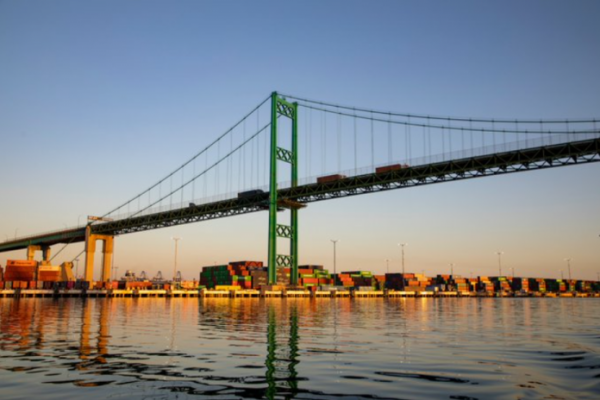
As Transport Stocks Sink, Los Angeles Port Volumes Soar

Fear of the supply chain crisis is fading. Transport stocks are crashing. Yet an enormous amount of cargo is still flooding into U.S. ports.

On Tuesday, the Port of Los Angeles reported better-than-expected volumes for March — it was the port’s best March ever, the fourth-best month in its history, and it capped the best-ever first quarter.

Total throughput was 958,674 twenty-foot equivalent units, topped only by May 2021, October 2020 and August 2020. First-quarter throughput was 1.8 million TEUs, up 3.5% from last year’s record January-March.

March imports were 495,195 TEUs. As with total throughput, it was the fourth-highest import monthly tally ever and the highest since last May.

Los Angeles imports
Chart: American Shipper based on data from Port of Los Angeles

Huge gains versus December

The sequential month-on-month surge in imports is particularly telling. March’s imports jumped 17% from February’s. Imports in March were up 29% compared to December, when inbound volumes hit their lowest point since June 2020, a month when America was in the midst of lockdowns.

Los Angeles imports
Chart: American Shipper based on data from Port of Los Angeles

Rising import volumes normally signal greater supply chain pressure ahead. In this case it may be the opposite.

Record cargo volumes have been stuck waiting in ship queues off U.S. ports. The drop in Los Angeles’ December numbers in the run-up to Christmas was not due to a falloff in demand for import services. Rather, it was due to landslide bottlenecks that prevented more cargo from being offloaded from the queue.

In March, actual volume arriving in California from Asia should be seasonally reduced due to the February Lunar New Year holiday in China. But imports surged as more ships in the queue were offloaded. Between the beginning and end of March, the number of container ships waiting off Los Angeles/Long Beach fell from 60 to 48, or 20%, according to statistics from the Marine Exchange of Southern California.

“Here’s what I think is behind our strong first quarter,” said Port of Los Angeles Executive Director Gene Seroka during Tuesday’s press conference. “First, better fluidity on our docks. We’ve been working at this for a long time and it’s paying off. We have fewer vessels waiting in the queue and more velocity on the terminals. We also have a lot more room to maneuver on the terminal tarmacs.

“Second, we’ve got more workers on the docks, with fewer shifts being cut. That’s because we’re past omicron. And third, we’re using more data than ever.”

Too soon to sound the all-clear

When the final unwinding of the supply chain crunch happens, it should look like an increase in import volume at first (as offshore queues are offloaded), followed by a downturn.

The Port of Los Angeles numbers are following the first part of the pattern, but it could be just a temporary reprieve. Not only are reductions in the West Coast queue slowing, if not reversing, but port congestion on other coasts remains extremely high.

The Los Angeles/Long Beach queue fell to just 33 container ships on April 4. There were 46 container ships waiting on Tuesday, up 39% from that low.

Chart: American Shipper based on data from Marine Exchange of Southern California

Off East/Gulf Coast ports, ship-position data from MarineTraffic showed continued very high queue levels on Tuesday afternoon. There are 64 container ships waiting in total, with the Charleston, South Carolina, queue at 16, New York/New Jersey 13, Houston 12, Virginia 11, Savannah, Georgia, six, Freeport (Bahamas) three, and one each off Philadelphia, New Orleans and Jacksonville, Florida.

Meanwhile, there is no evidence yet of a significant dropoff in import bookings. FreightWaves has a proprietary index of ocean shipping import bookings to the U.S., measured in TEUs, indexed to January 2019. This index remains at over 200, at around the same level it was this time last year.

US ports container imports
Chart: FreightWaves SONAR

By FreightWaves

California Growers Had Hoped For A Wetter Winter

As we get deeper into spring, concerns continue to grow in California over drought following a winter that wasn’t as wet as hoped for.

“We had a really good December. But there’s been limited rainfall and snow since the beginning of the year,” says Tom Conrado of Classic Fruit Company in Fresno, CA. “The snow pack is non-existent at the last measurement–there’s not much left up there. They’re predicting six to eight inches of snow in the hills early this week. But if the runoff is already going, that precipitation is going to stay in the ground.”

Conrado points to storage water capacity continuing to be an issue–the lower storage capability for California’s water system in years like this mean the state doesn’t have the capacity to catch any early run off. “It got so hot so fast that the snow started to melt and we started getting run off and there’s nowhere to put it. If we had better capability for the storage, it would lessen the impact on the state. It’s not just farmers,” he says.

Fallowed crops
There are several other consequences of a drier than hoped for winter. “Any row crop is going to be looked at first as far as fallowing ground. Because you already have an investment in your permanent crops whether it’s trees or vines,” says Conrado. “Those crops will also be affected too by maybe not enough water to finish or get through the season.”

Water allocations could also be affected. “You’re going to see zero percent allocations and there’s definitely going to be more fallowed ground out on the West side at least. The East side is also facing water restrictions,” he says. The lack of water will also strain underground pumping even further.

Higher costs an issue too
This all comes at a time when growers in California (and across the country) continue to see higher production costs and limitations on some production materials. “On top of all of this is the lack of fertilizer right now and the high prices is an issue. But what can you do? You need it,” says Conrado.

He also notes another key casualty of California’s drought–the small towns in the growing regions. “There’s less work for the populous and it’s driving the population to get out and go somewhere else. It really hurts these municipalities,” he says.

This includes smaller growers. If for instance, larger growers have to fallow 1,000 acres, it’s likely that’s only a smaller percentage of their overall acreage is affected. “Compare that to someone who farms 4,000 acres and has to fallow 1,000 acres. That’s 25 percent,” he says. He also notes that the deeper pockets of larger growers mean they’re more likely to be able to manage the higher water costs. “They can go and purchase water outside of the region,” says Conrado. “It seems like every day you’re hearing a higher number of what someone has to pay on a per acres basis and it’s pretty astonishing.”

By FreshPlaza

GLOBAL OVERVIEW FRUIT LOGISTICA

This week, from Tuesday April 5 to Thursday 7 April, Fruit Logistica was held once again in Berlin. Back again after two years of the COVID-19 pandemic, the fresh produce sector travelled from across the globe to Berlin to come together in person once more.

FreshPlaza was again present with editorial teams from the Netherlands, France, Italy, Spain, China, Germany and English-speaking countries. All in all, exhibitors and visitors alike were visibly pleased to be able to exchange ideas and generally talk to each other together again, on site. Although many noticed that there were fewer exhibitors and visitors than in pre-COVID times, this did little to dampen the mood.

There was much discussion, among other things, about the uncertainty in view of the continuing supply bottlenecks and the long delivery times, as well as about the consequences of the pandemic and the enormously rising costs on the market. Some halls were buzzing with people, chef and product tastings and demonstrations, while other cocktail parties were enjoyed by all, proving to be a big hit that drew the crowds and interest. Booths were practical and functional with plenty of glossy material and a lot more QR codes in place of business cards on display. Fittingly, a lot of fresh produce was on display in most halls and available for tasting. The exotic fruits from Latin American countries were simply great to behold and taste when on offer. At the end of the day smart watches told the story of 10 000+ steps per day, with many visitors comparing who took the most steps. Among them were our editors, who share a breakdown of experiences at Fruit Logistica 2022 by country below!

Netherlands: Relaxed atmosphere at Fruit Logistica 2022
After an absence of two years and two months, the Fruit Logistica took place again this week in Berlin. 225 companies from the Netherlands took part. In the ‘Dutch halls’ 3.2 and 1.2, it was particularly noticeable that the fruit importers and fruit-vegetable cooperatives were absent this year. (Horticultural) suppliers were well represented. After a quiet start on Tuesday, it was certainly not as full as before on Wednesday, but at times it was pleasantly busy at the fair. Moreover, many exhibitors indicated that the quality of the visitors was higher than in previous years. The lower number of visitors also created a more relaxed setting. The time when many innovations were presented at the fair is over and with this period of high costs and logistical challenges, everyone seems happy to get their business through this period. Among greenhouse vegetable growers, high gas prices are the talk of the town, importers are full of logistical challenges and many European fruit growers are taking stock of last week’s frost damage.

Belgium: Belgian companies present novelties despite hectic market and frost worries
Among the Belgian fruit growers, much of the attention was still focused on last week’s unexpected frost. Chairman of the Belgian Fruit Auction (BFV), Ludo Lousbergh, explained that the frost could still have consequences for the pear harvest. Because of the frost, many fruit growers have had anxious days in the run-up to the Fruit Logistica. According to Ludo, the harvest could be significantly affected by the frost. Nevertheless, the chairman states that a large part of the pears can still be saved. Maybe the volumes will decrease a little bit, but this does not have to cause panic immediately, according to him. Due to the oversupply of pears on the market, a smaller harvest could even be beneficial for the prices. For apples, it remains to be seen what the damage will be.

Besides these news items, the companies mainly drew attention to their product range and novelties. For example, Coöperatie Hoogstraten and BelOrta presented their new lines of packaging. Hoogstraten also introduced a new ‘white’ strawberry, called Summer Whites, and BelOrta talked about its ‘Earth’ label, with which it wants to help growers during the transition from conventional to organic cultivation, which can take quite a while. Bel’Export also presented the new red pear and Devos Group brought the yellow Rubis Gold to the attention of the visitors. Despite a hectic market and a later period in the season, many did their best to introduce the new products to the public. Nevertheless, there is still a lot of uncertainty.

Germany: Exuberant conversations, restrained mood
Around 2,000 exhibitors from over a hundred countries were able to present their products almost the same as before. As the COVID measures in Berlin have been loosened, exhibitors and visitors were once again able to meet old, as well as new, faces. The mood among those present was mostly good, although quite subdued, as some German-speaking producer companies had cancelled their participation. But the lack of presence of many foreign exhibitors, such as from China and Russia, was also noticeable.  

Sustainability continued to be the most dominate topic, as presentations of various packaging and marketing concepts showed, such as that of this year’s Innovation Awards nominee, Schur Star Systems.

UK: Excellent quality of visitors, despite some big name companies missing
This year most of the British companies came together in Hall 8.2, some in a row of stands organised by the CHA, as the number of companies exhibiting with the CHA was the biggest yet. In the same hall there were a number of other British companies with their own stands. There were a few big names missing, but also quite a few new companies present. In addition to Hall 8.2 there were a good number of companies throughout the exhibition ground. The exhibitors all seemed very pleased with the quality of the visitors, numbers may have been lower but plenty of business was done.

France: Good quality discussions, despite lower attendance
Despite a lower attendance than was usually seen pre-pandemic, with 75 exhibitors on the French pavilion and a rather calm first morning, the results of this edition of Fruit Logistica are rather positive. With more time to talk, the discussions were of very high quality. Many presented their new packaging, meeting the requirements of the AGEC law. As for stone fruits and apples, concerns reigned over the damage from the frost currently raging in French orchards. Some participants could not be present in the end, because they remained alongside their teams to protect the orchards from frost. Overall, everyone was happy to meet again and satisfied with this less crowded but high quality edition. 

Italy: “A signal of restart that gives hope” despite lower turnout
Our Italian editors spoke with dozens of exhibitors, collecting the most diverse comments, although the common denominator could be summed up by one remark: “the second day was much better than the first, but there was far from a full turnout from all over the world. At least, however, a signal of restart has arrived that gives hope.”

Some pavilions were particularly penalized, especially those on the lower floors and far from the entrance flows. The two halls with the majority of Italians, all things considered, registered a discreet presence on Wednesday. Certainly, foreign visitors were a minority here, except in the case of organized meetings.

“The fair didn’t go badly for us over these two days,” commented Massimo Ceradini of KingFruit, “as we had prearranged a series of meetings. A few new contacts also came through”.

Matteo Mazzoni of Mazzoni Group is on the same wavelength: “We had agreed on numerous appointments with customers from different countries and they all went well. I believe that the purpose of trade fairs is mainly this: to meet and consolidate existing relationships. Then we welcome all new contacts.“ However, not all comments were positive.

“Well, things went a little better than the first day, but not by much – says exhibitor Federico Ponti – However, it would have been difficult to do worse than the first day.” 

For others, the second day of Fruit Logistica made up for the first day, which, according to exhibitors in hall 4.2, had had a slower pace. Certainly not everyone had had the same perception, but the emptiness of the spaces left by the many absent exhibitors amplified this impression.

“We didn’t stop for a moment,” said a farmer from Sicily. “There were many visits that we received at the Sicilian pavilion and this has heartened us, after the first day had been a bit disappointing. A lot of contacts with foreign companies, from Northern Europe, but also from the Middle East”.

Many companies that, due to the uncertainty, were not able to confirm a stand this year, however, have not failed to make their presence felt as visitors, leaning on those who were present. 

Spain: High Spanish attendance, despite missing big firms
A significant number of Spanish companies didn’t exhibit this year, including big firms such as Citri&Co, SanLucar, Cultivar, CMR, Eurobanan or Trops.

One of the main topics among the Spaniards was the recent frosts in the Northern stone and top fruit growing areas, which will affect considerably the planning of the new season. Meanwhile, rains are making it complicated to proceed with the citrus campaign, which has been especially complicated this year. The weather is also influencing the supply of soft fruit and vegetables, the prices of which are very interesting this year for Almería growers.

The high costs and the strikes are one of the main worries for Spanish growers and packers.

In spite of all that, Spain was once again in the top 3 countries for attendance.

The biggest cooperative  Anecoop didn’t miss the show, which celebrated the 30th anniversary of its Bouquet Seedless watermelons. The only Spanish nominated company for the innovation awards was the La Palma Cooperative, for its Amela tomato.

This variety of tomato, grown in Granada and coming from Japan, competes with other innovative proposals, such as an orange Romanesco cauliflower -rich in beta-carotene-, flying robots for harvesting fruit, vertical pea plants, 100% deep red lettuce or packaging for salads made with plastics from the sea.

Serbia: Serbian exhibitors seek alternative markets for Russian sales 
Some Serbian exhibitors were slightly disappointed with the placement of their pavilion, as it was very close to the wardrobe in Hall 2.1. That being said, everyone could see the Serbian stands after hanging up their coats, so in the end it did give the exhibitors some traffic. For most of the exhibitors, the goal was to find some new markets in Europe, as exporting to Russia has become more difficult for them. 

Egypt: Egyptian exporters find new contacts for Russia alternative
As the citrus season is over and with Ramadan starting in early April, there were fewer Egyptian stands than in previous editions. The exhibitors who were present state they were very pleased to be able to meet their clients after two long years of the pandemic. Some exporters stated they were looking for alternative markets to Russia, and succeeded in finding new contacts during their time at Fruit Logistica. 

Greece: Focus on kiwis, watermelons, grapes, potatoes and sweetcorn among Greek exhibitors
The Greek exhibitors in Hall 2.1 had a lot of kiwi traders, as the season for kiwis was wrapping up. A variety of larger stands combined with many smaller stands, which had a variety of fruits to exports, like watermelons, grapes, potatoes and sweetcorn. Traders were very happy to meet both existing as well as new clients after two years of tradeshow-drought.  

Turkey: Turkish stands stood out with fresh look
The Turkish stands looked quite modern with a nice blue covering most of Hall 1.1. Turkish traders were focused on the upcoming cherry and fig season, but also had soft fruit, citrus and apple traders among their number. On Wednesday, it seemed a lot more crowded than on the Tuesday.

Israel: Israeli companies display technological innovations
While many companies reported that the exhibition was a bit slower, they had an opportunity to meet old and new clients. A lot of technology innovations were on display too with eager visitors taking photos and videos of robotic pickers of apple harvesting being demonstrated.   

South Africa: Travel uncertainties no obstacle for South African pavilion
The South African pavilion was a bit different this year, as the organisation was a bit last minute due the change of date and travel uncertainties. For the first time it was funded and organised by the industry, it was a bit smaller than normal but every bit as busy. One industry member said that the industry organisations stepped in, as not being at Fruit Logistica would have been a disaster for them.

China: Traditionally large number of Chinese participants missing due to COVID-19 lockdowns
Due to COVID-19 flaring up in China and consecutive lockdowns and travel bans, there were virtually to no Chinese participants at this year’s Fruit Logistica.

Traditionally, quite a large contingency of traditional Chinese products including ginger, garlic and onion attended the exhibition, in addition to technology providers and IoT service providers. In the last few years, a growing number of Chinese importers and trade companies also exhibited at the show.

China’s ‘Covid-Zero’ policy has made international travel from and to the country difficult to virtually impossible. With recent Covid developments in large cities including Shanghai and Shenzhen, it is impossible to predict when this situation will ease. Chinese exporters face high transport prices and delays in shipment times when supplying global markets.

Southeast Asia and East Asia: Lower number of participants
A few companies from countries including Japan, South Korea, Thailand and Taiwan exhibited but numbers were not comparable to earlier years. Also trade visitors from this region were significantly less.

North America: Positive experience for North American participants
US companies and associations from Texas were reported to have had a very good and busy first day especially with many, visitors and clients. The cocktail functions of companies and chef demonstrations were especially a hit with visitors.

Mexico: Strong interest in Mexican pavilion
Companies found the exhibition very busy with a lot of interest in their produce such as avocados, pineapples and exotic fruit in Europe especially. The Mexican pavilion was buzzing with people having meetings, tasting products, smiling and shaking hands.

Ecuador: Negative effect of Russian invasion puts dampener on mood at the Ecuadorian pavilion
The atmosphere at the Ecuadorian pavilion was mixed. Excited to be back at Fruit Logistica and being able to travel to Europe. At the same time Russia’s invasion of Ukraine and the following suspension of exports to Russia has hit Ecuador’s trade significantly. Ecuador is a large banana producer and producer of other tropical fruits, of which a large part was sent to the Russian markets.

Feedback from exhibitors indicated that a number of Ecuadorian growers and shippers have gone out of business in recent weeks, or are facing bankruptcy. As Ecuador exports significant quantities of bananas, it will not be easy to find alternative markets, if they can be found at all. A number of companies are trading organic bananas.

Some new opportunities were on the horizon with the opening up of China for Ecuadorian yellow dragon fruit, or pitahaya. First shipments are expected for June and July later this year.

Chile: Focus on trade negotiations at Chilean pavilion
A large community of Chilean growers and exporters were present at the Chilean pavilion, with trade negotiations taking place at the different tables. Chile’s exports to China have been hurt in the last two years due to trade disruptions by Covid, delays at ports and quality issues after arrival. A focus on quality control during harvest, packing and transport has been addressing some of the issues. Alternative markets are also sought in Asia, Europe and the US.

Colombia: Exotic tasting sessions attract new clients for Colombians
This pavilion was full of exotic fruits like on display and available for tasting with many companies reporting to have had a good exhibition. They met with new clients while also seeing a strong interest from European countries especially in the organics category. Some say the show had slightly fewer people, but they still had focused meetings with good potential clients.

Argentina: New companies present at Fruit Logistica for the first time
Argentina had a few companies at Fruit Logistica for the first time with the hope of meeting new clients and exporting to Europe. Other companies hope to expand exports to Europe, UK and further afield. They were happy with the interest of new clients.

Uruguay: Plenty of interest for Uruguayan companies
This year Uruguay had very few companies but those present at the show were busy in meetings all day showing the interest was good from old and new clients.

Costa Rica: Costa Ricans eager for European export opportunities
Another newcomer to Fruit Logistics, Costa Rica also had some companies attending for the first time. They were happy with the interest shown and eager to export to Europe especially.

Dominican Republic: Good experience for Dominican Republic at Fruit Logistica
Reported to have a good and busy show with companies finding interested potential clients. Europe was a big focus.

Peru: Lively Peruvian pavilion presents significant growth
Peru’s fresh fruit production has experienced significant growth in recent year, making the country on par with large Southern Hemisphere producers such as South Africa and Ecuador. A lively pavilion with companies trading avocado, grapes and blueberries, in line with newly established productions in the country itself.

By Fresh Plaza

California Has Driest January Through March In 100 Years

Despite record-breaking storms in October and December 2021, California water agencies will receive just 5% of what they requested. That’s down from an allocated 15% in January.

The state is enduring the third year of its second acute drought in less than a decade. And the beginning of 2022 was the driest January through March stretch in 100 years.

“For January to March 2022, the statewide precipitation, about 2 inches, will mark the lowest in the 100-year record for this time frame. On average, this time frame usually brings about 11.5 inches,” said Maggie Macias, who works in public affairs at the California Department of Water Resources.

The second and third driest January through March period happened during the state’s last major drought. The years were 2013, with 3.01 inches of rain, and 2015, with 4.48 inches of rain, according to Macias.

The Department of Water Resources reduced the State Water Project allocation to 5% of requested supplies for 2022. The department previously set the allocation at 15%, but the historically dry months of January, February and March required a reduction in the allocation to conserve available water supply, according to a news release.

Because of the extra-dry spell, statewide reservoir levels are about 70% of average. The statewide Sierra snowpack has also fallen to 55% of average for this date, most of that snow coming from heavy snowstorms in December, the release said.

A final allocation for the water year is typically announced in May or June.

“We are experiencing climate change whiplash in real time, with extreme swings between wet and dry conditions. That means adjusting quickly based on the data and the science,” Karla Nemeth, director of the Department of Water Resources, said in the release. “While we had hoped for more rain and snow, the department has been preparing for a third consecutive year of drought since October.”

Ian LeMay, president of the California Fresh Fruit Association, said the 5% allocation is worrisome.

“Our best-case scenario will be to balance pumping and surface deliveries from lakes. We must rely on our aquifer,” LeMay said.

The low allocation of water is a big hit to California growers, and the state will enforce its first water pumping limit.

“This is the first drought since the Sustainable Groundwater Management Act, also known as SGMA, was instituted,” LeMay said. “Groundwater sustainability means there’s a limit to what growers can pump. They can no longer pump what they need.”

Without enough water, growers will be forced to decide which crops get water. Last year, 385,000 acres were left fallow because of the drought. LeMay already expects it will be far more this year.

“Where I put my focus is on California’s $60 billion surplus,” LeMay said. “Some of that money can be invested to fortify our water infrastructure right now.”

By The Packer

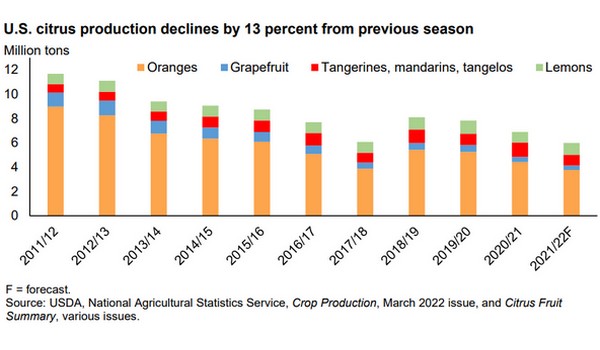
Supplies In US Citrus Market Forecast To Be Record Low

The 2021/22 U.S. citrus crop is forecast to be 6 million tons, down 13 percent from the final output for the 2020/21 season. Declines in overall production are due to smaller orange and grapefruit crops in California, Florida, and Texas, and smaller mandarin crops in California and Florida.

All orange production in the State of California is expected to decline by 5 percent, split between 4 percent reduction in non-Valencia orange production (navel and early/mid-season varieties) and a 9 percent reduction in Valencia oranges from last season. The Florida all orange supply forecast dropped by 5 percent from the February 2022 forecast and is expected to be 22 percent below last season. Orange supply is expected to be below levels of 2017/18 when Hurricane Irma hit Florida. Decreased production of oranges, grapefruit, and tangerines are expected to result in increased imports and higher prices compared to last year.

Price Outlook
Fresh Fruit Producer Price Index Increases at Start of 2022 The February 2022 fresh fruit producer price index (PPI) was 172.06 (1982 =100), up 4.5 percent from January 2022 and up 13.3 percent from February 2021. The February PPI increased for two consecutive years. Grower prices for fresh citrus, apples, and grapes increased in the beginning of the year driving up the PPI.


USDA, Agricultural Marketing Service, U.S. Mexico Canada Agreement Seasonal Perishable Products Weekly Update continues to report weather events, transportation issues, and increasing input costs along the supply chain such as fuel, containers, labor, and other costs.


Click here to view the full report.

Source: ers.usda.gov

By Fresh Plaza

GLOBAL OVERVIEW ONIONS

The global onion market is very varied at the moment. In Europe the outlook is generally good, with Italy and Spain experiencing particularly high prices, and Germany seeing an increase in demand. This is needed, as many countries continue to feel the squeeze of higher costs of production, as well as logistics. For the most part, the harvests seem to be positive, although France has seen fewer larger sizes this season, and in North America poor weather during the growing season has lead to less produce from the Pacific Northwest.

The Netherlands: High costs, low import and export of onions
Dutch onion exports are particularly tame these days. “Processing onions is very expensive everywhere at the moment. The costs for transport and processing have risen dramatically”, says a Dutch exporter. “There are no shortages in Europe, Brazil is not on the market yet and things are also very quiet overseas. Miraculously, we have been able to send onions to Ivory Coast for a long time, but otherwise it is very tame. Exports have been far too low for the last four to five weeks. Exports are still ahead of last year, but there are also an awful lot of onions in the whole of Europe.”

Dutch onion exports already passed the 1 million tonne mark for the 2021-2022 season in the first week of March. That is three weeks earlier than last year. According to another exporter, the expected reduction in acreage for the 2022/2023 season will ensure less pressure on the market next year. “Also internationally, I expect that growers will opt in larger numbers for potatoes and grain because of the upward pressure on the price of these products due to the tensions on the world market. This is therefore likely to result in less interest in onion cultivation.”

Imports of onions are also down a lot. “However, it is expected that considerably fewer New Zealand onions will be shipped to Europe this season. “Figures indicate that there are already 50% fewer New Zealand onions coming to Europe,” says Derk van Stokkum. Due to weather conditions, New Zealand has a smaller harvest at its disposal anyway, especially in the thicker sizes (65+). In addition, in the Netherlands and elsewhere in Europe there are high yields of good quality onions. Large retail customers will therefore continue to use European onions for a long time and will not switch to imported onions until the end of May at the earliest,” expects a Dutch importer.

Germany: Demand increases by 10%
A large wholesaler from South West Germany sells onions sourced from Lower Saxony, the Netherlands, the Lower Rhine and Bavaria. Since Bavaria has problems quality-wise, they can offer only little this year. Therefore, he will primarily receive onions from Lower Saxony. From mid to late April on, the company will purchase onions from New Zealand and South Africa, which will be offered until June, when they will be replaced again by the marketing of Palatine onions. Currently they receive around 350 tons each week.

The trader says that compared to recent years, the demand has increased by about 10% this year. Lower Saxony has expanded its volumes, while the Netherlands is marketing its goods strongly in the North of Germany. Into April the market will be switching to imported goods, which in turn may mean that the old goods will no longer find buyers.

In Frankfurt, onions from Turkey are sold at €13 and 80 mm+ household onions at €11 per 25 kg bag are supplemented at a high volume level, while a voice from Hamburg says that onions from Chile will not be available until the 14th week, and quotations for Spanish cold storage goods were picked up on Monday. Although household onions from New Zealand and Australia are also expected, the bulging domestic stocks did not allow the same venture.

France: Good quality but lack of larger sizes of onions
With the onion season already well underway, professionals now have the goods stored in refrigerators. The 2021/22 season is characterized by a good quality, both for yellow and red onions. However, there is a lack of large sizes for all onions, which is also observed at the European market. The French production of red onions being almost finished, wholesalers will therefore for some, soon switch to the Egyptian product.

It’s almost April, so prices are slightly up, because you must now add the costs of storage and sorting, and the consumption is identical to last year’s, so a rather good and regular consumption.

Italy: High prices for white onions
The onion market in Italy is going through the transition between the last stocks of domestic produce and the start of imports. A trader from the northern Italy says that currently white onions are in demand, but there is not much volume available and prices are quite high. On the other side of the spectrum, the red onion has stalled a bit and shows normal prices, around average for the period. Italian onions, both yellow and white, are still in stock, with good quality thanks to optimal storage. The first shipments of onions from India have arrived in Italy, but not at low costs, also due to the increase in container freight.

In addition, there are some problems with some retail chains that do not want to pay higher prices to producers and traders due to increased general prices.

Spain: Price 80% higher than this time last year
The onion stocks are much lower than last year in Spain, so prices are around 80% higher compared to the same period last season, in which price levels were too low. In about 20 days the harvest of the first early varieties will kick off in Andalusia, where the acreage has dropped down significantly due to the bad results of last season and the current high costs. The fuel, fertilizers and energy costs are so high and the profit margins are so tight for onions that many Spanish growers are switching to other products with more attractive profits. The sowing period of mid and late varieties – the most representative of Spain in terms of volumes – is still in progress and the abundant rains in March have made it difficult to enter the fields. This and the high costs are already causing a noticeable drop of around 40% in the acreage. The impact in the international markets will be therefore very significant.

Egypt: Egyptian onion market feels effects of COVID
The spring onion season in Egypt has concluded. After a slow start, things were much more stable by the end of January. As well as shipping prices increasing, some containers were even sent to the wrong destination, leading to spoilage of the produce once it had actually arrived at the correct destination. This meant that 75 to 85% of the produce had to be discarded. Demand for spring onions was negatively affected by lockdowns, which were put in place to deal with a new wave of the coronavirus. Demand was very slow in the beginning of the season, especially before the Christmas time. Prices were also very low and disappointing as a result. After the holidays, the quantities in the market started to drop. Exporters started to realize they’ll have to deal with the current market situation differently than usual, due to COVID.

China: Export price increase
The sales season of onions from Shandong and Gansu is almost over. The price of yellow onions left in storage is rising. Only Yunnan is currently harvesting fresh onions and market demand is huge. The onion harvest in Yunnan was somewhat delayed this year. The onions from Yunnan normally enter the market in large volumes in the middle of March, but this year it was late March before Yunnan onions began to enter the market in large volumes.

The price is relatively high because weather conditions were not great, so the overall production volume declined. The current price of 80mm red onions outside the warehouse is around 2.0-2.2 yuan [0.31-0.35 USD] per kg, while the price of yellow onions is around 2.8-3.0 yuan [0.44-0.47 USD] per kg.

The prices of various vegetables went up as a result of snowfall in Yunnan as well as pandemic control measures earlier in the season. The price increase of onions is relatively small compared to some other kinds of vegetables. Moreover, the relatively low price stimulates market demand, so domestic product movement is quick.

As for export, the relatively high price creates difficulties for onion exporters. The factory price of peeled onions is normally around 300-400 USD per ton. The current price is around 800 USD per ton. The high price is a result of reduced production volume, and pandemic control measures. Many production areas go through temporary lockdowns, and the difficulties with the harvest, processing, and distribution push the price up. Moreover, oil prices are rising and that has an impact on transport costs, which in turn affects the price of nearly all products.

The production volume of Yunnan onions is relatively small, but there are no other production areas that supply the onion market at the same time. That is why market demand is strong. Yunnan primarily exports onions to Korea, Japan, and Southeast Asia. We expected the price of onions to come down in late March as the supply volume expands, and so we started to prepare for the first export orders, but the price went up instead. We have no choice but to delay our export plans.

North America: Lower supply and high demand give good prospects for onion season
The spring season for onions has begun out of both Mexico and Texas.

“The quality and demand for onions are both excellent,” says one shipper. “Vidalia is up next and will officially begin April 12th. Our crop there is looking good so far and we anticipate a normal year. Then we’ll get started in Walla Walla, WA in June.”

Along with supplies of onions out of Mexico and Texas, other areas coming on with fresh crop include Georgia in April, then California and Washington later this year.

“Due to weather issues in the Pacific Northwest last summer, the overall supply of onions is much lower this year than last. We will wrap up our Northwest storage crop next month and be fully into our new crop onions until the fall,” says the shipper.

Not surprisingly, demand is stronger this year for onions compared to last year. “The market is very strong and is higher than last year.  We can attribute this to the lack of storage onions in the Northwest,” he says, noting domestic storage crop is at a record low this year.

Meanwhile, challenging the industry are a variety of issues including freight rates at an all-time high and labor costs. However, the shipper notes that the onion industry was beginning to change before the pandemic and it was a shift only accelerated by COVID. “Growers only planting for confirmed sales, labour challenges, the general price of onions in stores… all of these factors have drastically changed the planning procedures and outlook when it comes to our grower partners,” he says.

Looking ahead, with more fresh onions coming into the market, more choices will be available for consumers. 

And with spring and summer around the corner, promotions will be too. “Consumers are excited to get out and enjoy warmer temperatures. Grilling, picnics, parties, special events and holidays are all great opportunities for sweet onions and we encourage our customers to promote with confidence,” says the shipper.

Peru: “Right now, freight for onions would cost more than the product itself”
The export onion industry in Peru has experienced constant growth in recent years thanks to its main export market, the United States, which in 2021 represented the destination of more than 60% of Peruvian shipments.

The long season in the country, which lasts from week 27 to 12, ends as the North American fields begin to have their own harvest. However, shipments of Peruvian onions have also gained strength in Europe, with Spain in the lead, and Central America, and continue to reach new markets; among the last to receive onions from Peru are Canada, Portugal, Belgium or Haiti. In this last destination, exports have started with important volumes.

However, currently the increase in logistics costs is posing a great challenge for the sector and stands as the greatest limitation to continue growing, since as recognized by an important exporter of this industry in Peru, “at the moment, the freight of the onions would cost more than the product itself.”

“For now, the onion plantings have already started. From what I see, they are going at the rate they have always been, but in the sector we have all started with uncertainty, hoping that between now and June the freight issue will normalize.”

Australia: Onion exports up by 23 percent
While most fruit and vegetable crops suffered a hit during the pandemic, volumes of onions were up, according to the latest figures. For the year ending June 2021, 271,930 tonnes were produced (an increase of 3% on the previous year) and valued at $203million (down 17 percent) with 9 percent sent to processing. In terms of exports, volumes jumped back after a significant drop off in 2020; 44,885 tonnes were exported, with a value of $30.4million. Although the value remained roughly the same, the volume was up 23 percent. In terms of domestic consumption, 75 percent of Australian households purchased onions, with the majority of production occurring in South Australia and Tasmania.

Meanwhile, New Zealand and the UK signed a historic free trade agreement, earlier this month. In a social media post, the country’s peak onion body says it is a “great outcome for NZ onion growers and exporters. This agreement will eliminate tariffs on NZ onions and put us on an level playing field with other countries which already have no tariffs, such as Holland.”

By Fresh Plaza

Peruvian 2021/2022 Table Grape Campaign Exceeds Expectations

The 2021/2022 Peruvian table grape season is coming to an end, and despite difficulties, the season ended up exceeding industry expectations, aided by favorable marketing conditions in its receiving markets.

Three weeks before the end of the 2021/22 season, the Peruvian Table Grape Producers Association (Provid) does not expect any changes to its updated projections published in mid-February, it told to Agraria.

According to its figures, the season will exceed 64 million boxes of table grapes shipped, reflecting an increase of 12 percent and positioning itself as the world’s second biggest exporter of table grapes by volume.

Provid pointed out that the growth is mainly due to the different varieties available, and that this season there has been a 37 percent increase in white seedless varieties and 22 percent in shipments of red seedless grapes, until January.

After the Peruvian table grape harvest, Arturo Hoffmann, commercial manager of Don Ricardo, assured that “success has also been seen thanks to the best prices, which is the result of the market dynamics that implies the exit of the grape from Californian table and the delay of Chilean arrivals.”

By Produce Blue Book

Peru’s Table Grape Exports Haven’t Surpassed Chile’s Export Volume But They Surpassed Their Value

“In the short term, Peru will be the world’s leading supplier of table grapes”

Peruvian table grapes exports amounted to 1.26 billion dollars in 2021, i.e. 22% more than in 2020, greatly surpassing Chilean table grape exports, which totaled 928 million dollars.

This was announced last month by the Ministry of Foreign Trade and Tourism (Mincetur), which indicated that the country positioned itself in 2021 as the world’s leading exporter of fresh grapes. However, according to the president of the consulting firm Inform@cción, Fernando Cillóniz Benavides, Chile continues to be the world’s leading supplier of table grapes in terms of volume.

“In volume, Chile leads shipments of this fruit. Peruvian grapes, however, have surpassed them in value because Peruvian grapes receive better prices than Chilean grapes,” he said.

Peru is set to become the world’s largest supplier of table grapes by volume in the next campaign (2022/2023) or in the following one (2023/2024), Cilloniz stated.

“Chile’s table grape supply is stagnant. It’s even contracting, while Peru’s supply continues to grow. I think that in the short term our country will be the main global supplier of this fruit, displacing Chile to second place,” he said.

“Peru has more and more late grapes (which are exported in February and March) so if Chile reduces its volumes in those months our commercial window will continue to expand,” he added.

By Fresh Plaza

US West Coast Port Congestion Starts To Ease As Imports Divert To The East

Average vessel waiting times for berth and labour have improved significantly at the San Pedro Bay ports of Los Angeles and Long Beach in the past few weeks, halving the number of queueing ships to below 50.

Moreover, according to the latest data from the Los Angeles Signal port optimiser platform, the average waiting time at LA terminals has fallen to 3.1 days, with some facilities reporting little or no delay.

Supply chain disruptions in China, improving landside operations and the continuing coastal shift to the hitherto less-congested US east and Gulf coast ports are seen as the main reasons for the easing of congestion.

However, a report from New York-based supply chain and freight platform Shifl suggests that improved inventory levels and a downturn in consumer demand could also impact import volumes.

“The Fed’s decision to raise interest rates to address concerns about inflation could result in a slowdown in retail demand at a time when inventories appear to have reached levels last seen in March 2020,” said Shifl founder and CEO Shabsie Levy.

“It appears that, after two years of turmoil, shops are finally fully stocked. What happens next on the world’s most important tradelane depends on how fast the Fed puts the squeeze on inflation,” he said.

However, despite the weakening fundamentals, the appetite of major BCOs to take charge of their supply chains by chartering their own ships appears not to have lessened. Indeed, shipbrokers continue to report new fixtures, including a two-month extension of the 2,756 teu X-Press Mekong at a massive $180,000 a day.

According to VesselsValue data, the sub-panamax ship is due to arrive at Vancouver, Canada today, on hire to Honolulu-based transport and logistics group Pasha Hawaii. However, The Loadstar understands that it has leased the ship on behalf of Canada’s automotive, hardware, sports and household goods retailer Canadian Tire.

At the TPM22 conference at Long Beach this month, Canadian Tire VP of transportation Gary Fast alluded to voyage and time charter deals that he said had assisted the retailer. He said: “When you can’t find capacity, you have to take care of your supply chain.”

Meanwhile, New York-based Blue Alpha Capital has published February throughput data for the top 10 US container ports.

While container imports to the east coast were up 27.3% in February, compared with the same month of the year before, to 1,029,183 teu, they were skewed by the earlier timing of Chinese New Year. However, February imports to west coast ports increased by just 5.9%, to 1,025,545 teu, emphasising the continued coastal shift of cargo.

The report’s author, John McCowan, said there were three factors driving the growth in imports through the east coast gateways. He said: “First, the initial pandemic volume surge disproportionately benefited the west coast ports, and that is impacting current comparisons. Second, shippers have elected to change routing decisions for loads that would have gone to west coast ports to east and Gulf coast ports to avoid the widely reported congestion.”

Mr. McCown also identified a third reason: reduced linehaul costs from using east coast-calling vessels compared with the cross-country intermodal service via the west coast.

By The Load Star

FMC Pressuring Ocean Carriers To Boost Exports

Regulatory action to increase market access for US shippers under consideration

The Federal Maritime Commission will consider taking regulatory action against ocean carriers that are not providing sufficient services to U.S. exporters and their overseas markets.

The FMC announced the stepped-up pressure on Monday as part of an expansion of the agency’s Vessel-Operating Common Carrier Audit Program, which the FMC launched last year to assess the market power of the nine largest container carriers operating in U.S. markets. 

The audit program will begin evaluating how shipping lines are serving U.S. export shippers in addition to its initial focus on detention and demurrage policies.

“American exporters deserve access to ocean transportation to sell to international markets every bit as much as overseas sellers get access to U.S. markets,” said FMC Chairman Daniel Maffei.

“If the shipping companies continue the cooperative attitude they have by and large shown the Audit Team to date, I am confident we can make progress on some of the issues that have frustrated exporters. That said, the Commission is committed to an ocean transportation system that serves exporters as well as importers and I will not rule out any action within the bounds of the law that helps us achieve that goal.”

Special attention to ‘pop-up’ carriers

As part of the expanded audit, the FMC’s Bureau of Enforcement (BoE) will begin looking into the services offered to U.S. exporters by five independent container ship lines that do not traditionally operate in U.S. trade lanes — they recently entered the market in response to historically high rates shippers are paying for U.S. imports.

“All ocean carriers calling the United States have an equal obligation to conduct themselves in accordance with the law,” Maffei said. “New entrants to the market — including the so-called pop-up carriers — have all the same responsibilities as companies that have served the U.S. trades for decades. We are especially interested in how the identified companies plan to serve the U.S. export market and how those business models comply with requirements under statute.”

In a separate statement, FMC Commissioner Carl Bentzel said that after visiting the Port of Long Beach earlier this month, he was concerned that such new market entrants are providing only import service and choosing to move empty containers back to China instead of filling them with exports.

“These carriers could be behaving in a manner that violates common carriage protections of the law,” Bentzel warned.

Loaded exports at the adjacent Port of Los Angeles in February were down 5.7% from the same period last year. Exports at the port have declined 36 of the past 40 months. At the same time, empty containers shipped back to Asia for reloading jumped 18.6% compared to last year due to the heavy demand for American imports.

Exporters log impacts

U.S. exporters, meanwhile, have conducted their own survey to illustrate the effects that the market and corresponding economic decisions being made by the container lines are having on their business.

The survey, conducted by the Agriculture Transportation Coalition (AgTC), measured “carrier service reliability, carrier communication, acceptance of export cargo, freight rates, additional charges (demurrage/detention), chassis shortages, marine terminal congestion, and other factors” affecting agribusiness exports in 2021.

It found that roughly 20% of total confirmed export sales were lost due to carrier undependability, declining export cargo or uneconomic pricing (for the U.S. seller and overseas buyer), and predatory add-on fees. The value of the lost sales ranged from $120,000 to as high as $65 million.

The survey also found that 85% of U.S. agriculture exporters report that overseas customers have shifted some of their purchases to other countries due to lack of dependable delivery time and additional costs. Most of the companies reporting lost sales noted that they are then “forced to sell on the domestic market, generally at significantly lower prices, often at a loss,” according to the survey.


By FreightWaves

U.S. Potato Exports Remain Strong, Reports Potatoes USA

Denver, Colo. – With the Potatoes USA 2022 annual meeting underway March 7-9 at the Brown Palace, the organization reports that U.S. potato exports remain strong.

From July to December 2021, most U.S. potato and product exports were above levels for the same period in 2020. However, supply and shipping constraints negatively impacted the figures for December, noted Potatoes USA in a March 8 news release.

Some of the biggest gains were made in U.S. exports of frozen potato products, which increased by 9% from July to December 2021 compared to 2020 — led by a 41% increase in exports to Canada, reports Potatoes USA. The lift is more notable given that exports were off by 12% in December.

Increases in frozen potato product exports to Canada, Central America (24%) and Mexico (22%) are likely partly because of easier shipping to these markets, says Potatoes USA.

Exports to target markets in Asia were up 3%, led by an 85% increase to the Philippines, finds Potatoes USA, which further notes that the country was severely impacted by COVID-19, resulting in serious declines in 2020. And while exports to Japan were up 6%, supply chain issues have caused restaurants in Japan to limit fry sales.

Shipping problems and tight U.S. supplies have triggered declines in exports to a number of countries, says Potatoes USA, including Korea (down 14%) and Taiwan (down 12%).

Tight supplies and logistics issues are also impacting U.S. exports of dehydrated potatoes, says the organization. Total exports were down 9% but did show some improvement in December, off only by 6%. Both Mexico and Canada, two of the largest markets, were down 3% and 10%, respectively.

Potatoes USA finds exports remain strong.
(Photo courtesy of Potatoes USA)

U.S. exports of fresh potatoes, which include table-stock and potatoes for processing, were very positive, reports Potatoes USA. The total was up 16% thanks to a 23% increase to Canada, the largest market by far, and Mexico, up 20%, despite the continued restrictions to the 26-kilometer border zone. However, Canada did have a 10% decline in December.

Fresh potato exports to Central America were up 37%, led by 104% growth to the Dominican Republic. Exports to Asia varied, with exports to Taiwan, the largest market, down 19%, “as significant problems with rejections have limited exporters’ willingness to ship,” notes Potatoes USA. “The Philippines and Thailand were down 20% and 43%, respectively, due to strong competition from low-priced potatoes from China.”

From The Packer

close
Loading…