Romaine Demand Climbs Back Post-recall

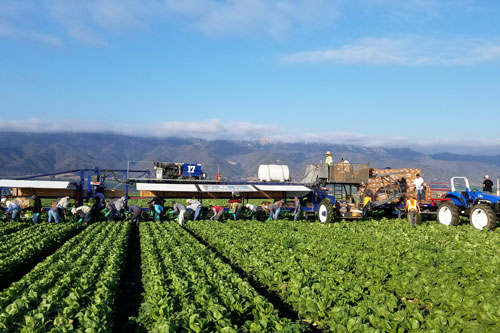
Romaine demand is starting to pick up again following the mid-November recall and advisory warning on romaine lettuce grown in the Salinas, Ca. region.

On Nov. 22, the Centers for Disease Control and Prevention in Atlanta, Ga., was released following, at that time, the reporting of 40 cases of E. coli O157:H7 infections in 16 states.

“Now I think everyone’s struggling with the “black eye” of this even though that was on romaine in Salinas only and we’re in Yuma, Ariz.,” says Greg Beach of Salinas, Ca.-based Steinbeck Country Produce Inc.

Steinbeck, whose product wasn’t recalled, has been growing in Yuma for more than a month and that season goes generally until early April. “Our production of romaine is super stable. We’ve been very pleased with the quality and the output of romaine and romaine hearts right now,” says Beach, who notes that production is similar to last year at this time.

Consumers coming back
He does add that time is helping. “I think with every day it gets better and comes back a little bit,” he says. “The key is: we need to keep doing the right thing with the safety and quality of the product. Those are the variables that we can control.”

What helps is the good demand romaine tends to see at this time of year. “There are holiday parties for Christmas and New Year’s. Thanksgiving is just one day whereas holiday parties are on the weekends and there are Christmas lunches so there’s pretty good demand throughout the month,” says Beach.

That said, right now, pricing is lower than Beach would like to see it, which is likely connected to the Salinas recall. “But looking ahead, weather will be the main factor in the next four to five weeks on pricing,” he says. “It’s been pretty nice down here so there’s beautiful product with great yields. But if we start to see cold weather down in Yuma, that will shut down production and we’ll see the prices go back up.”

By Fresh Plaza

Overview Global Garlic Market

The prices paid for Chinese garlic have fluctuated a lot lately. They are currently high, and that is having an impact on the European market. It is worth noting that garlic grown in Europe is gaining more and more ground in many European markets, as consumers are looking for an environmentally-friendly alternative to Chinese garlic. In the US, imports from China have been hit hard by the increased import rates, giving a boost to the demand for domestic garlic. Mexico and Peru are happy with the campaign’s results.

The Netherlands: Garlic in China is more expensive than what we can make here
According to importers in the Netherlands, garlic sales are fairly stable. As a result of the licensing system, fairly stable volumes are coming in, but the high price in China is having an impact on the market. The price of garlic in China is higher than what we can make here, importers say. According to them, this is the result of pure speculation, because the cold stores are packed. The selling price of garlic currently ranges between 18 and 23 Euro. The period between early November and mid-December is traditionally a busy one when it comes to garlic sales, and this often also applies to the period after mid-January.

Germany: Small sales peak and early start of the Egyptian season expected
German garlic importers are very pleased with the current sales. “A small peak in sales is expected in the period leading up to Christmas,” said a specialized importer. Dutch products will be offered until the beginning of January. However, due to the lack of supply, the price is rising considerably and a switch to Egyptian products is expected to happen earlier than normal.

Spanish goods are expected to be exported to Germany until May / June, after which they will immediately switch to the new Spanish harvest. Here too there are talks of shortages and a significant rise in average wholesale prices.

In addition to the aforementioned suppliers, China remains one of the main players in the global garlic market. “Due to the growing demand for environmentally-friendly local alternatives, the European productions are gaining ground at the expense of Chinese goods. For this reason, we are also seeing more and more garlic of German origin. Given the generally excellent product quality and the support from consumers, I also expect gradual growth in this product segment in the coming years,” says a trader.

France: Volumes available until March
There is still garlic available on the domestic market. Some suppliers will be able to offer it up to and including March. Just like other European countries, France has been dealing with quality problems. The demand is good, mainly due to the fact that supermarkets and wholesalers are increasingly interested in French garlic, and as long as stocks are available, they will continue to purchase this garlic. The planting of the new garlic has been delayed somewhat by the constant rainfall in November. In fact, some growers are still working on the planting.

Spain: Better season than last year
The Spanish garlic harvest finished at the end of August. A total of 280,000 tons were harvested. The acreage has been reduced by 20% compared to last year. This was particularly noticeable in the Castile-La Mancha region, where most Spanish garlic is grown.

Many growers stopped growing garlic after the dramatic season of 2018. This season was marked by extremely low prices and quality issues. The rains in May 2018 took a great toll on the quality of the early harvest from Andalusia and the purple garlic from Castile-La Mancha, which were harvested in June. This year, the quality is better because the weather has remained dry during the harvest period.

The high prices of Chinese garlic and the better quality of Spanish garlic have led to a better market situation with acceptable prices, even though they do not yet accurately reflect the good quality of the product. Spanish exporters do not understand why Spanish garlic is still cheaper in Europe than the garlic from Argentina or China. “It seems impossible to raise prices. This has to do with two things. On the one hand, many growers are in a hurry to sell their garlic, given last year’s bad experience. On the other hand, large distributors have huge bargaining power. The supply of Spanish garlic is very spread out. The atomization of the supply, combined with the arrival of new, inexperienced growers, has made it difficult for garlic prices to rise,” says a spokesperson for a garlic association.

Earlier this year, Brazil was prevented from imposing higher import rates on the garlic from Spain and other European countries. As a result, Brazil is still Spain’s largest market outside Europe. Spanish garlic exports have increased by 10% thanks to new overseas markets, such as Canada and the US. Prospects point to the 2019 stocks running out before the new harvest of 2020 hits the market.

In Andalusia and Castile-La Mancha, the white and purple Spring garlic have already been sown. Purple garlic is now being sown in Castile-La Mancha. This will last until mid-February. The rental prices for the land are very high and this is delaying the expansion of the acreage. It looks like the acreage will remain stable next year.

Italy: Small harvest and high prices
This year there is not a lot of Italian garlic available and prices are higher than in 2018. The main production areas are Emilia-Romagna, Veneto, Campania, Sicily and Abruzzo.

“Garlic prices are about 20% higher than last year. Spain is a major player on the Italian market. In general, the quality and quantities are satisfactory and do not differ much from previous years. The average price on the wholesale market stands at around € 2.30 per kilo, but this differs per variety. A striking development is that there have been sustainable innovations in the field of packaging,” says a trader from Abruzzo.

An agronomist from Basilicata says that he is dealing with a 15% drop in the production. “This is due to the climate issues that we faced in the spring.”

According to another trader, the prospects for Europe are not good. “The European market is in a dip. The demand is low, there are many different countries on the market and there is a lot in the cold stores. We are hoping for a market revival so that current stocks will be sold by the time the new harvest comes on the market in May or June.”

Ukraine: Volumes are rising steadily
The garlic acreage is expanding yearly in Ukraine. “It is a short season, as the garlic is on the market from August to November. From October to July there is mainly Chinese garlic on the shelves. This is mainly due to a lack of good storage facilities in our country,” says an exporter.

According to the exporter, Ukrainian garlic has a lot of potential. “It has a strong taste and large cloves (4-6 cloves per bulb).” The biggest markets for Ukraine are the Baltic states and Belarus. Smaller quantities are also sold to Poland, Germany and Great Britain.

It has been a challenging season for the Ukrainians, because the sizes have been small. Some companies saw opportunities because small garlic is very well-suited to industrial purposes.

China: Fluctuating prices
The new garlic came on the market in June this year. The price of the crop has fluctuated a lot in recent months. In the beginning of the season, prices were high, but then they dropped again, only to reach high levels once more in October. The prospect is that prices will fall again in the coming months, as more supply comes on the market. Yet the price is still relatively higher than last year.

The garlic season reaches its peak during Christmas and the Chinese New Year. The demand for Chinese garlic is high now and that also causes prices to rise. Since there is now also a greater supply on the Latin American market, Chinese companies are focusing more on the European, Asian and African markets, as well as on the Middle East.

Mexico: Good season with great prizes
Garlic is grown across all parts of Mexico. The harvest period differs per region. The total season runs from March to July and the main varieties are purple garlic, white garlic, Chinese purple garlic and the early California garlic. The weather conditions were good this year and the harvest started on time. Compared to previous years, Mexico has had a very good campaign, with good prices on both the domestic market and the export market, mostly because there has been no market saturation. The quality has been better than usual and the volumes have also increased. On average, the yield stood at around 14,000 kilos per hectare. Garlic is grown on around 6,500 hectares throughout Mexico. The state of Zacatecas, which has ​​3,000 hectares devoted to Chinese purple garlic, supplies the largest volumes. The biggest competitors for Mexico are China, Spain and the US.

Peru: Shortage of large sizes and opportunities in the US
The Peruvian garlic season runs from October to January. The harvest started on time this year and went well. Most garlic is harvested in November. In terms of volume, it was a normal season, but sizes have turned out to be smaller than usual this year, a trader says. “There is a shortage of large sizes. Markets such as Australia and New York demand large sizes, and it has been difficult to deliver them. There seems to be no specific reason for the smaller sizes. Maybe the seeds were not as good as in previous years. It is not a consequence of the weather conditions, which have been good this year.”

Due to the high import duties on Chinese garlic, the US is now more open to other suppliers. “Exports to the US are increasing, but not to an overwhelming level for Peru. The US market mainly demands white garlic and this comes mainly from China, Argentina and Spain. Countries such as Peru, Egypt and Mexico mainly supply purple garlic, which doesn’t yield much in the US.”

United States: Major impact of import rate on Chinese garlic
In May, after the import tariff on Chinese garlic increased from 10% to 25%, things started slightly changing on the North American garlic market. The demand for Californian garlic is huge. “Every week, the demand is 10-20% higher than in the same week last year,” says a trader. “The demand has been on the rise since July. At first, it was 4-6% higher compared to last year, but in September and October this percentage rose quickly.” The market is expected to be tight in early 2020. In the US, there is an increasing demand for organic garlic.

Argentina has just started shipping garlic to the US. It is said that the harvest there is 30% lower than last year. Meanwhile, Spain is also shipping garlic from its cold storage facilities. The question is whether the country will be able to continue supplying garlic until the start of the new harvest in May 2020. Traders hope so, because California does not have enough volumes to supply the entire country. Peru and Chile are also exporting small volumes to the US.

Despite the increased import rates, the volume of Chinese garlic on the US market is currently rising. The Chinese are shipping a lot ahead of the Chinese New Year. With the festivities, exports come to a standstill for almost a month. The Chinese New Year is taking place on January 25.

Due to the high demand for garlic, prices are good. A trader expects even further increases in this coming quarter. Prices for fresh imported garlic oscillate between $ 40 and $ 50.

Australia: Production sharply increasing
Australia is only a small garlic producer. In the season that finished in June 2018, a total volume of 2,246 tons worth $ 15.6 million had been harvested. 90% of this was sold on the fresh market, another 5% went to the industry and 5% was exported. The production is growing. This time, the volume was 26% higher than in the previous year.

In the same year, Australia imported 12,224 tons of garlic, mainly from China and Spain. The country only exported 118 tons. Australia supplies five different varieties from two growing areas: Queensland’s Lockyer Valley and Victoria’s Sunraysia.

By Fresh Plaza

China and U.S. Reach Phase One Trade Deal Agreement

Pictured: Treasury Secretary Steven Mnuchin, Chinese Vice Premier Liu He, and U.S. Trade Representative Robert Lighthizer (Photo Credit: Xinhua/Liu Jie)

China and the United States have been going back and forth on plans for trade deals and tariffs between their economies. Following threats from China and several appeals made by U.S. companies to the Trump administration, the two announced this morning that they have entered phase one of a monumental deal. Details of this deal are currently few and far between, but signs point to a promising turn of fate for those operating between China and the U.S.

According to CNBCthe two countries have reached a trade deal that is expected to provide relief on tariffs as well as increased opportunities for agricultural purchases. Additionally, rumored structural changes will include intellectual properties as well as technological challenges. While not many details were disclosed, Chinese officials briefed reporters and the U.S. President touted the agreement as an “amazing deal.”

From what is currently available, we understand that the U.S. will relieve tariffs placed on Chinese goods in phases, which the news source stated was a priority for Vice Commerce Minister Wang Shouwen of Beijing. Shortly afterward, the Trump administration stated that the next round of tariffs will be canceled by Sunday. Further details include the U.S. plans to leave 25 percent tariffs on $250 billion imports, while cutting duties on $120 billion worth of products to 7.5 percent. The news source stated that China is also considering a cancellation of Sunday’s tariffs.

Beijing’s Vice Minister of Agriculture and Rural Affairs, Han Jun, said that agricultural purchases are also expected to increase significantly. As part of the deal, the U.S. President insisted on the Chinese purchase of American crops, according to tweets. Furthermore, both countries plan to make adjustments to intellectual properties, technology transfers, and financial services, according to CNBC.

Although the trade deal has yet to follow through with legal procedures in Washington and Beijing, the two are building out a timeline for finalization.

By AndNowUKnow

Fresh Apples in Storage up 15%; Galas and Red Delicious Close

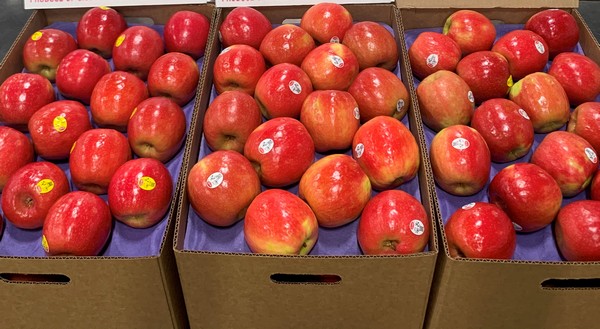
U.S. fresh apple holdings on Dec. 1 totaled 118.3 million cartons, 15% above year-ago levels, according to the U.S. Apple Association, with red delicious and galas neck and neck.

The association’s monthly Market News report also said that the total number of apples in storage on Dec. 1 was 161.7 million bushels, 17% above a year ago and 3% higher than the 5-year average.

The association’s first storage report of the season 

Washington state accounted for about 85% of all fresh U.S. apples in storage on Dec. 1, according to the report.

Fresh gala holdings were 25.1 million bushels, up from 21.1 million bushels last year and 24.7 million bushels two years ago.

Red delicious fresh supplies in storage were down slightly, with 25.2 million bushels in storage this year compared with 26.2 million bushels two years ago and 31.6 million cartons two years ago.

The new Cosmic Crisp apple from Washington, available for the first time this year, totaled 325,700 bushels on Dec. 1.

The report said 7.3 million bushels of golden delicious apples were on hand, up from 4.8 million bushels a year ago but down from 7.7 million bushels two years ago.

Granny smith apples in storage totaled 14 million bushels, up from 10.4 million cartons last year but down from 16.6 million bushels two years ago.
Honeycrisp apples in storage totaled 12.5 million cartons, up from 9.3 million cartons last year and 8.7 million cartons two years ago.

Pink Lady/cripps pink fresh apples in storage on Dec. 1 tallied 5.6 million bushels, up from 5.3 million last year and 5 million bushels two years ago.

Prices for fresh apples are down slightly so far this year, according to the U.S. Department of Agriculture. The average grower price for fresh apples in October was 39.1 cents per pound, down from 41.6 cents per pound last year and off from 46.3 cents per pound two years ago.

By The Packer

The Violence is Inherent to the Regions, Not to the Avocados

Aaron Acosta on Reports of Violence Surrounding the Avocado Industry.

Avocado production and consumption has grown exponentially in the past decade. The expansion of the industry has led the fruit to be dubbed “green gold” in reference to the value that is placed upon it within the global markets, as well as the profits to be made by the people who work with it.

Mexico is the largest avocado producer in the world, and many areas of the country have benefited from the fruit’s success. There have been, however, many reports in the news about violence surrounding this product in Mexico. In a recent episode of the Netflix original show ‘Rotten,’ the focus lay on “The Avocado War,” and the involvement of cartels in this industry.

Villita Avocados is a fully vertically integrated avocado company who have farms in Michoacán, Mexico and distribute the fruit in the United States. Aaron Acosta, the company’s corporate relationship manager, responds to the reports of violence in the area and says: “It is important to retain a global view of the entire industry. It is easy to pin the avocado as something more than just a healthy, delicious fruit, and see it as a currency. In general, however, the violence that is occurring is inherent to those states; it is not inherent of the avocados. This violence could, and likely would, happen with any profitable business – it’s not about the commodity itself, but rather it is about the money that the avocados are able to make.”

He continues: “The violence is definitely present, but it is just a danger of operating in that area. It is present, but we don’t consider it a hazard to our day-to-day operations. Of course, we are not immune to the disruptions and our employees’ safety is always our greatest concern. There have been times when there have been upticks in the violence, and then we aren’t able to operate at 100% capacity because we want to avoid the situation and keep our employees safe.”

In August of 2019, some USDA officials who were working out of Michoacán experienced first-hand some of the issues in the area. “I would note that when the USDA personnel witnessed some of the violence I approached a private security firm to provide us with a detailed operational risk report for the importers association but nothing materialized.  In the end we went forward with the assessment as part of internal operational guidelines. It gives us a sense of not only present concerns but future risks as well,” Acosta concludes.

By Fresh Plaza

Shaping the Future of Farming: Latest AI Tech for Accurate Citrus Yield Estimates Lands in the USA

With Aerobotics, crop yield estimation is up to 95% accurate

After much anticipation, Aerobotics has launched its Citrus Yield Estimation product and is offering a 33% discount to US growers signing up during December (see below for more details). The product was successfully trialled with premium citrus growers in the USA and South Africa during 2019.

Aerobotics is a global precision-agriculture company that uses high-resolution drone imagery and artificial intelligence to assist growers in monitoring their farms, and optimize and estimate their upcoming yields. Aerobotics has a global impact on farm production and is shaping the future of farming through AI and crop monitoring software.

Aerobotics’ proprietary machine-learning models up to 95% accurate
Aerobotics serves growers with farms that cover more than 130,000 hectares across 18 countries, including Australia, South Africa, the UK, New Zealand, the US, Chile and Russia. The company is working with partners in Spain, France and Portugal. In Africa Aerobotics has carried out operations on commercial farms in Kenya, Tanzania and Malawi.

Many growers struggle to estimate yields accurately year-on-year. Poor yield estimates pose significant opportunity costs and reputational risks to all parties involved. With Aerobotics, crop yield estimation is up to 95% accurate. Their technology is positioned to provide early-stage accurate estimates, before key business decisions about crop maintenance and sales projections are made.

How Aerobotics tackled yield estimation challenges
During 2019, Aerobotics ran several private trials in South Africa and in the United States of its new Yield Estimation product for citrus, aimed at helping growers, packers and marketers with better yield estimates on their citrus crop.

The Yield Estimation product uses cutting-edge technology to help in many areas of farming and enables its clients to be more competitive in a global market. The product takes the guesswork out of the yield estimation process, giving citrus growers, packhouses and exporters access to actual production rates early in the season.

Increased accuracy early in the season means that growers can lower their costs, boost profits and decrease risks. With a select number of drone flights throughout the season, growers are informed on yield estimates at the early stages of maturation enabling them to make decisions early on about interventions and resource requirements.

Equipped with better crop estimates, growers can gauge the market and optimize their marketing and packhouse strategies, including resource planning, in preparation for harvest.

Precision-agriculture product improve profitability by providing detailed production information at early stages in the season, giving them sufficient time to adjust sales and marketing strategies.

The process
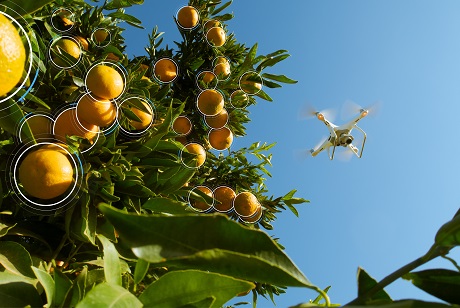
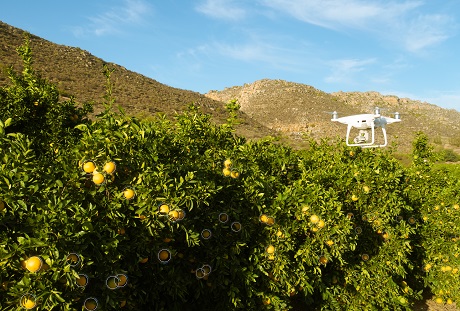
A drone automatically flies to a representative set of trees in the orchard. It drops down to a tree and records a short video. Aerobotics’ proprietary machine learning models identify the fruit and estimate its size and color.

In order to make this information more useful to clients, the Aerobotics in-house agronomy team has designed growth curves for different citrus cultivars. The technology relates current production values to historical yield production levels in order to provide accurate estimates of fruit size and color.

The regular drone flights allow growers to track fruit growth and provide this data to packhouses and marketers, and manage fruit size through irrigation and fertilization. Closer to harvest, it enables growers to make harvesting decisions based on color, and to identify the optimal harvesting period.

The Yield Estimation product boosts profitability and reduces costs by offering:

  • accurate reports on fruit size distribution to be expected at harvest date
  • fruit size distribution charts and fruit color reports from flight dates and throughout the season
  • alerts to stressed trees and zones
  • tree census and missing tree counts
  • pre-tree analytics including chlorophyll index, NDVI, volume, canopy area

How you can sign up
Contact our Head of Business Development USA, Alastair Curtis, if you’re interest in signing up for the Yield Estimation tool for the upcoming season.


Aerobotics is offering a 33% discount to US growers signing up to the Yield Estimation tool, for the month of December only.

By Fresh Plaza
Overview Global Sweet Potato Market

The popularity of sweet potatoes among consumers has grown enormously in a short time. The most important sweet potato producers in the European and North American markets are the United States, Spain and Egypt. The supply is large this season, especially for Spain, which will have a substantial production in December. The weather conditions have had an impact on the yield in a number of regions. The Italian harvest has been halved, and in the US it has started later than usual.

The Netherlands: Large volumes from the US and supply from Spain and Egypt still available
The sweet potato harvest in the US is much larger than last year’s and this is resulting in a somewhat stiffer start to the season, as there is still a large supply from Egypt and Spain available. While in the previous campaign it was quite difficult to find sweet potatoes for a competitive price, now there is actually some oversupply. Nevertheless, the Dutch expect the market conditions to improve this month, with Christmas around the corner and the customers now buying from Egypt and Spain switching to the sweet potatoes from the United States. Moreover, the strawberry season has started in Egypt, which means that fewer containers are available to ship sweet potatoes. In fact, this is often the sign that Egypt is going to stop exporting sweet potatoes. The popularity of sweet potatoes has increased enormously in the Netherlands in just a few years and the country is conducting more and more tests with sweet potato cultivation.

Belgium: Prices are on the rise again
Before the winter months, high prices were being paid for the sweet potatoes from the United States and Honduras on the Belgian market. However, with the imports from Spain and Egypt, the supply increased and prices fell quickly. At the moment, prices are rising again ahead of Christmas due to a reduction in the supply. The quality of the sweet potatoes from the US has been better than that of the Egyptian and Spanish.

Germany: Winter supply consists mostly of overseas products
After the good start of the season in European growing areas in August, the market has remained lively until well into November. The start of the Egyptian campaign was also relatively successful, although there has been some oversupply and very low prices since October. The supply from Latin America – especially from Guatemala – is currently on the rise. We see good opportunities for these tropical varieties (particularly for the Covington, Beauregard and Evangeline). “Between December and February, we are counting on good sales and stable prices,” said an importer.

In terms of trade volume, Germany is lagging somewhat behind Great Britain and Southern Europe, although consumption is also quickly increasing here. More and more growers are trying to produce the potatoes on German soil. These regional sweet potatoes are doing great in the local retail. In Switzerland, there has been a professionalization process underway. Under the name Batati, Swiss growers have succeeded in creating a central marketing cooperative and in supplying domestic retailers directly. They are now also trying to handle the class II product, which meets the requirements of retailers, under their own label.

France: Preference for Spanish sweet potatoes
The French sweet potato market is currently dominated by the United States, Egypt and Spain. The French market prefers the Spanish product, as it is much cheaper than that from the United States. The Spanish sweet potatoes are also fresher. The sweet potatoes are harvested daily and immediately exported. In the US, they are harvested all at once and kept in storage.

At the moment, prices on the French market range between 0.90 and 1.00 € / kg for the Spanish product and between 1.15 and 1.20 € / kg for the US one. In the long term, the demand is expected to continue to grow, so more French growers are showing interest in growing sweet potatoes themselves.

Spain: A lot in stock for the growing European market
At the moment, most Spanish sweet potatoes have already been made available. The harvest started in July and the warehouses are full of sweet potatoes intended for sale on the European market. Although there is a lot of competition on the market, with more and more local production, consumption continues to rise. Due to the growing demand, prices remain stable during most of the season.

This season, the volume is greater than last year, when the harvest was reduced due to excessive rainfall in the main producing regions. The quality is good this year and the demand is usually high around Christmas. After Christmas, the demand is expected to fall briefly and then increase again, as sweet potatoes are ideal as part of a weight loss diet. Furthermore, there is a good demand for the crop from the processing industry. In the beginning of the season, the demand was high while there was not much production on the market, although the domestic market is still small, certainly when compared to neighboring Portugal, where consumption is five times as high. The most important producing region is Cádiz, although more and more is being planted in Granada, Seville, Valencia and Alicante.

Italy: Yield this year halved due to spring weather conditions
Sweet potatoes are still relatively unknown on the Italian market, but that is starting to change. In the Venice region there has been a sharp fall in the production (around 50%). The main cause was the excessive rainfall recorded in the spring months during the grafting of this root vegetable. The price for the sweet potatoes somewhat compensates for the lower yield. The price on the Italian market currently amounts to between € 1.20 and € 1.50 / kg. The sale of sweet potatoes on the Venetian market is coming to an end this week.

“This year, our yield has been halved compared to previous years,” said a grower from Apulia. “We started our harvest in mid-August and there was interest from various traders. However, the prices offered fell below our expectations. The harvest ended in October. ”In Caraglio, Piedmont, the harvest of the “Batata Buona”, a niche of a niche, finished on November 6. There are currently around 9 growers devoted to the cultivation of this special variety and the market prospects are positive. The growers are based in Caraglio and Bernezzo.

Egypt: Highest prices ever at the start of the season
At the start of the Egyptian sweet potato season, the price was incredibly high; higher than it had ever been. This was due to the shortages in the United States and Europe. The price was more than four times higher than normal and covered the production costs more than 14 times. After a month or two, the price started to fall sharply following the start of the season in other countries.

China: Larger volume pushes prices on the market
In China, the earliest production areas, located in the south, start harvesting their sweet potatoes in July. Afterwards, the campaign gradually moves to northern areas. The harvest of the late variety kicks off in October. The season started a bit later than last year due to the abundant rainfall recorded during the harvest period. The rain has had a particularly big impact in Guangxi. The volume there has dropped by 20% this year.

At the moment there is a lot available on the market, as different production areas have all expanded their acreage. This is pushing prices down; in fact, they are now lower than at the start of the season. Furthermore, the production costs of sweet potatoes have increased this year, further reducing the growers’ profits. Since sweet potato cultivation has expanded so much, more and more companies are looking forward to exporting their products. Exports are already going to Europe and Canada, where the product is well received and there is a high demand. In China’s domestic market, sweet potatoes are especially popular in the north. In the south, consumers still need to get used to the product, so they are not eaten as often. A lot is also invested in new varieties, which are sold for better and more stable prices.

United States: Different reports about the market situation
Normally, the sweet potato harvest in the US starts around the end of July, but this year it kicked off in late August / early September. Due to the rainfall and the dry weather, the harvest obtained has fallen somewhat below average in most regions. In some states, such as Louisiana and California, there isn’t a lot in stock. California reports a 15-20% drop in the supply compared to last year. In North Carolina, despite the dry weather, the yields seem to be slightly better than last year.

The demand has been meeting the traders’ expectations, especially with Thanksgiving. With Christmas around the corner, the demand is not expected to fall. “Only in January does the demand slow down somewhat. The prices this season are higher and more stable than in previous years, mostly because there are no more old stocks from last year and the harvest is about average. In North Carolina and California, prices are above average, but growers are also dealing with more costs than usual.

Yet the reports differ per region. In California, the rain has caused the production to fall and to suffer some quality issues. The price has risen, but the costs are also higher. In Louisiana it is clear that the prices are back at the right level, because there is nothing more from last year in stock. In North Carolina, people talk about above average prices, but with an average market demand around Thanksgiving.

Australia: Peak season is imminent
The spring and summer months are the peak time for Australian sweet potatoes. Most states start producing in late December / early January. Only in Queensland, which accounts for 78% of the Australian production, is the crop grown all year round. Last year, 97,222 tons were cultivated (+11%), with a 16% fall in terms of value. The largest part is intended for the domestic market and only small volumes are exported, but those figures are rising. The most important markets are the United Arab Emirates (57%), Hong Kong (16%) and Singapore (15%). The most important variety is the Gold sweet potato (90% of the total production).

By Fresh Plaza

Murcian Leaf Vegetables Hit Once Again by Storms

“The rains have forced us to stop the harvest and delay the loading”

Heavy rains have again taken a toll in Murcia, Alicante, Valencia and other areas of the Spanish Levante. It has not been long since the DANA left the fields flooded in these producing areas, with leafy vegetables taking a lot of damage.

At that time, in September, the planting of the winter leaf vegetable productions was still underway, so although the damages were significant, growers suffered mostly delays in the start of the export campaign, as well as some production gaps. At this time, however, the production is in full swing.

“The heaviest rains were recorded in the early morning between Monday and Tuesday, although it continues to rain. We have been forced to stop the activity for a day and a half, as the fields have become inaccessible, some of them having completely flooded by such a huge amount of water in such a short time (between 80 and 130 liters per square meter depending on the area). We are now starting to access the fields in order to assess the situation,” says Ginés Navarro, of the sales department of the Murcia-based Agridemur company, specialized in the production of leafy vegetables and salad mixes.

Just like this company, the majority of producers in the Campo de Cartagena, which accounts for most of Murcia’s production of lettuce and other leafy vegetables, have had to stop harvesting, and in other areas, such as the Guadalentín Valley, Pulpí, and Águilas, the rains have not been as strong.

“At the moment, since we’ve had to stop harvesting, we are experiencing delays in the loading, so it will take us about two days to catch up with the orders,” says the producer and exporter. “Fortunately, this is a time when the demand for lettuce is not very high. In the next few days, the amount of orders could increase, but we do not expect big spikes, as the programs signed in advance with the large distributors have become more prominent over the past 8 years.”

“A week ago, we had had more than 17 consecutive days of strong winds which didn’t allow us to work in the fields as we would have liked. It has so far been a very difficult year due to weather adversities,” says Ginés Navarro.

By Fresh Plaza

CDC and FDA update E. coli Investigation; Onset Date Extended to November 18

UNITED STATES – As the FDA continues to seek a connection between the cases of the most recent E. coli O157:H7 outbreak and a singular source, it looks as though the investigation remains in effect, as well as the advisory for consumers not to eat romaine lettuce grown in the Salinas, California, region.

“CDC advises that consumers not eat and retailers not sell any romaine lettuce grown in the Salinas, California, growing region. This includes all use-by dates and brands of romaine lettuce from this region,” a CDC release dated December 4 states.

The PMA alerted industry members of the latest details in the investigation, noting that the latest onset date has been extended to include November 18, 2019. Previously the onset date was November 14. Illness onset dates reported are all prior to the warning issued by the FDA on November 22, according to the report.

As of December 4, the CDC and the FDA report that:

  • Reported Cases: 102
  • States: 23
  • Hospitalizations: 58
  • Deaths: 0
  • Recall: Yes

To see the full reports from the two parties, please click through: CDC and FDA. The most recent timeline of reported cases since can be found here.

We continue to remain on the lookout for the latest updates while hoping for a swift end to the outbreak and closure for all those affected.

By AndNowUKnow

Overview Global Orange Market

The southern hemisphere’s orange export season has already been finished for a while. Volumes appear to be disappointing in all production regions compared to the previous campaign. In many countries, the start of the season has been delayed because the fruit’s coloring was not yet up to the market’s standards. This was the case in California, Egypt and Italy. Both the lower harvest and the poor coloring of the fruit have to do with the temperatures and the dry weather.

The Netherlands: Demand for Spanish Salustiana’s continues to rise
The season for the South African oranges destined for juicing is coming to an end. The Spanish Salustiana’s from the northern part of the Spain have already started entering the market, but the southern harvest has been delayed by rainfall. Still, the demand for the Spanish Salustiana’s continues to increase.

The sales for the oranges overall are slow, according to a Dutch importer, and there is a large variety in the quality of the product on the market.


Germany: No Christmas rush for oranges yet
In Germany, the Christmas sales have started slowly, but Spain is currently in the lead, followed by Italy, Greece and Turkey, among others. Despite the Christmas rush, there is a normal market situation, says a wholesaler who mainly sells Spanish citrus. “We currently mainly trade Navelina oranges, and in the course of December we will also be bringing in some more Navel table oranges and Salustiana juicing oranges. I can only say that the quality leaves nothing to be desired. As soon as the volumes go up a little, the price will tend to fall.”

Organic oranges are also currently on the market, including those from Greece. Due to the weather conditions during the flowering, the season only started in mid-November, a few weeks later than normal. Nevertheless, there is an annual increase in terms of volume, particularly on the Swiss market, where organic citrus is gaining ground. “We already have 30% more orders than last year,” said one supplier at the start of the Greek citrus campaign.

France: Spain on the market, Morocco supplementing the supply
The South African season came to a close three weeks ago, and since then Spanish oranges have been filling the French shelves. There have been some problems with the fruit coloring, but the Brix levels ​​are okay. The Spanish production is not large this year and the sizes are small. The first Moroccan oranges are also arriving on the market, but the quality is not yet good enough at the start of the Moroccan season.

Spain: Smaller volume on the market
This year there has been a reduction in the Spanish citrus harvest, with mandarins and clementines (-35%) being much more affected than oranges (-15 to -20%). The demand for citrus is much greater than the supply, so prices are rising every week. Due to the smaller reduction in the harvest, orange prices are more stable. Last season, oranges achieved the best results when it came to sales, but this year clementines are playing the leading role. At present, the Navelinas are the most common on the market. The transition from the southern hemisphere to the north has gone well for Spanish traders. After all, countries such as South Africa and Egypt do not put large volumes of oranges on the market.

Italy: Delay in the coloring
An unsatisfactory yield has been obtained this orange season, even though the quality is good. Some growers in Sicily are optimistic because they do have sufficient volumes. The Italian orange trees have been decimated by the Tristeza virus. This virus is spreading across the island of Sicily. Approximately 5,000 hectares of citrus crops have been lost and replaced with new varieties that are resistant to the virus. A total of 49,000 hectares were devoted to ​​oranges in Sicily in 2017, with almost half of that located in Catania.

“The coloring of Italian oranges is not going well and that is causing scarcity on the domestic market,” says a Taranto grower. “The price on the wholesale market ranges between € 0.50 and € 0.75 / kg. The high temperatures in October and early November have delayed the start of the harvest by at least two weeks. It will certainly take another 15 days before the fruit is suitable for the market. ”Due to these problems, a 30% drop in the volume of Italian oranges is expected. Prices and sales are satisfactory at the moment.

Egypt: Navel season shorter than imagined
The Egyptian Navel season has been delayed by two weeks and that is making the season shorter. The Navels are pushed out of the market as soon as the Valencias hit the shelves in mid-January. The delay is due to poor coloring of the fruit. The short season could result in competitive prices. In addition to domestic competition, there is also competition from Spain, Morocco and South Africa.

China: Harvest is lower, production costs are rising
The time for the import of large volumes of oranges is over. At the moment, large quantities of Chinese oranges and mandarins are reaching the market. Many production areas in China suffered the impact of dry weather in the second half of the year, so the size of the oranges is somewhat smaller this year. In some cases, this has also caused a reduction in the harvest. Furthermore, oranges and mandarins have ripened a little later and, as a result, they reached the market later than last year. Another reason for the smaller harvest is the heavy rains recorded in the first half of the year, which took a toll during the flowering period.

The price paid for the oranges is high compared to other years. This is mostly due to the increase in the production costs, but also because huanglongbing has had a big impact on the Chinese market. This disease has already reached many Chinese production areas in recent years, and the harvest has been considerably reduced. In addition to the production for its own market, China also exports a lot of its mandarins and oranges to Southeast Asian countries. The Chinese production is doing well there, with the demand also increasing every year.

South Africa: Early Navels hardly lucrative
The season is over for South Africa. With 24.3 million boxes (15 kg) of Navels, the volume has been 10% lower than initially estimated. The Netherlands remains the most important importer with 57,000 tons. The export of Valencia oranges was also lower than expected. It had been predicted to amount to 52.9 million boxes, but it stood at 46.8 million, compared to last year’s 54.4 million boxes. The demand for South African Navels was affected by the supply of late varieties from Spain and Valencia oranges from Egypt. The early Turkish Navels also put pressure again on the late Valencias from South Africa.

Valencia oranges are doing better than the Navels, especially those of the growers who had the right sizes for the processing industry. There was even a period when any price would be paid for Valencias of the right size.

The northern Senwes region saw a reduction in the Navel production due to hail, poor coloring and probably also the impact of exhaustion after the previous season. The estimates point to a 27% drop. In the Eastern Cape, growers also struggled with the coloring on the late Navels, and just like in the Western Cape, they’ve had to deal with some wind damage. In the Western Cape, gigantic sized Navels “as big as ostrich eggs” have been harvested in some places after the recovery from the dry weather. In general, the early Navels are becoming less and less lucrative for South African growers, as their supply overlaps with the Egyptian Valencia season. Early Navel orchards are therefore being removed across the country.

Chile: Waiting for the 2020 season
The South American season has been over for months and it is still too early to say anything about the prospects for the 2020 season. In the 2019 campaign, the volume was somewhat smaller than in 2018, but the latter had been a record harvest. Chilean oranges compete on the market against Valencias from California and Navels from South Africa.

United States: Decent demand for domestic oranges
The supply is currently stable on the North American market. In California, Navel oranges arrived in early November and the last Valencias are being packed. The Cara Cara and Minneolas will come next. According to a trader, the volumes are roughly the same as last year, but the sizes are remarkably better this time. In Florida, work is currently underway with the Navel and Hamlin oranges. Here the harvest has also been better than in previous years. Hurricane Irma ravaged this region two years ago.

Although the harvest in California has been somewhat delayed due to poor coloring and/or lack of sugars, the taste is better than in the previous year, according to the growers. This is mostly due to the mild summer and cool autumn. In Florida, the season has also been delayed because the fruit’s sizes are still too small.

Market demand is currently decent. Certain imported products, such as the Midnight Valencias, are still on the market. Every year, growers from Florida and California have to deal with citrus imports from countries such as Mexico, South Africa, Chile and Peru. For the US, the market should pick up again in December. The price is currently around 15% lower than last year.

Australia: Exports to China on the rise
The most important export market for Australian oranges is China, with 26% of all shipments, or 50,204 tons of oranges. The second biggest destination is Japan. The peak season of the Australian Valencias is just around the corner and accounts for 13% of the total volume. The most important variety, however, is the Navel, which is grown in the winter. A total of around 52,089 tons of oranges worth €229 million were grown in 2018.

By Fresh Plaza

Healthy Volume of Small Washington Apples

Supplies of Washington apples are good, though beginning to tighten up slightly in some varieties and sizes.

“The 64ct have been a tough spot. Most of my customers have switched to a 72ct and that has made it easier,” says Jason Fonville of Ag Grower Sales, LLC. in Wenatchee, Wa. “The smalls on the other hand–so the 113s and the 138s–have been plentiful this year as opposed to the last two seasons. I have customers who take the smaller sizes so it’s a good year for us.”

Fonville also adds that supplies of Royal Galas are also slightly tighter with them coming out of controlled atmosphere storage ready for export. Consequently, prices have gone up on Galas. “But Red Delicious, Fujis and Granny Smiths were really tight this time last year and there are more available this year,” adds Fonville.

Delayed harvest
While Washington apples are all harvested, Fonville notes it was a late finish to the season. “Everything seemed delayed and then we had some cold come on when the growers were getting the Pink Ladys and the last of the Granny Smiths off the trees,” he says.

As for demand, after a somewhat slow start to the season, demand is now steady for apples. “I plan on being busy all the way into the new year,” says Fonville. “Demand has been good for all varieties of apples. I do see demand for the Red Delicious going down, though, as the club apples start to become more popular. It didn’t look so great for the club varieties three to four years ago but now they are starting to change the market a little bit and customer demand is up.”

That said, pricing is somewhat low currently. “This isn’t typical,” says Fonville. “The volume and size that I personally sell for example —113s, some 64s and 72s, mostly the smaller sizes — in the smaller profile category there are plenty of apples to fill demand. Lots of bagged apple deals out there,” says Fonville. “But I think the pricing on the retail side for the higher grade are good this year. They were off a little bit from last year’s pricing but they’re not bad.”

By Fresh Plaza

U.S. Trade Deficit in Fresh Produce Widens

The U.S. trade deficit for fresh produce will widen to $16.3 billion for fiscal year 2020, up 3% from fiscal year 2019 and up 15% compared with fiscal year 2018.

The U.S. Department of Agriculture issued its report on the Outlook for U.S. Agricultural Trade on Nov. 25. The USDA projected U.S. fresh produce exports for the year ending Sept. 30 2020 will reach $7.1 billion, while imports of fresh fruits and vegetables will reach $23.4 billion.

For all of U.S. agriculture, the USDA projects total exports for fiscal year 2020 at $139 billion, while U.S. imports of agricultural projects will reach $132 billion. That results in a projected trade surplus of $7 billion for fiscal year 2020, up from $4.5 billion in fiscal year 2019 but well off from $15.9 billion in fiscal year 2018.

The $7.1 billion forecast for fresh produce exports is steady compared with the August estimate, as the USDA said Canada and Mexico have been stable markets for U.S. shippers. The USDA said a $1.7 billion gain in expected fiscal year 2020 imports compared to the agency’s August forecast was due to increased shipments of avocados, berries, and melons from Mexico.

Global growth slows
The forecast for world gross domestic product growth for 2020 has been revised downward to 1.5% from 1.6% in the August forecast, according to the USDA. U.S. growth forecasts remain unchanged, with 1.6% growth expected in 2019 and 1.3% for 2020, according to the report.

“Despite positive consumer sentiment, low unemployment rates, and strong year-over-year wage gains, growth has been moderated by continuing uncertainty in U.S.-China trade, Brexit, and slowing trade and investment globally,” the USDA report said.

With USMCA waiting for ratification in Canada and the U.S., the report said Canada and Mexico face “modest to unfavorable” per capita growth prospects in the near term.

In Canada, per capita growth is pegged at 0.1% for 2019 and at 0.4% in 2020. Meanwhile, the USDA said per capita growth in Mexico is forecast at -0.8% in 2019 and flat for 2020.

Ratification of USMCA will boost economic prospects for both Canada and Mexico, according to the USDA.

Latin American per capita growth is forecast for -0.4% in 2019 and 0.7% in 2020. The USDA predicts per capita growth in Asia and Oceania at 3.4% for 2019 and 3.3% for 2020, both 0.3% lower than the August forecast. Per capita GDP growth in the Euro Zone is forecast at 1% for 2019 and 0.9% for 2020.


By The Packer

Brassica Growers Suffering ‘Worst Flooding for Decades’

UK brassica growers are suffering the most severe and sustained flooding they’ve ever seen, according to a leading producer.

The experienced grower estimated that around 20-25 per cent of total UK production had been lost in the current season, with almost all growers across the UK’s brassica-growing heartlands of Scotland, Yorkshire, Lincolnshire and Cornwall affected in some way.  

He added that the heavy rain – which began in the summer and is affecting a whole host of other products, including potatoes, onions, carrots and parnsips – will likely lead to quality issues since brassica crops have been sitting in water for a long time and are going into store wet.

“I’ve only been growing brassicas for 30 years, but we’ve got men on the farm who have been working in this industry for 40-plus years, and nobody has seen rain as heavy and sustained as we’ve seen lately,” he told FPJ. “Normally flooding comes and goes within a few weeks but this has been ongoing now since the summer.”

He added: “As a grower, you might have a handle on crops that are currently being harvested but when it comes to crops that still need to be harvested through until spring of next year it’s an unknown quantity.  “All we do know is that crops have been sat in water for an awful long time – they’re giving up, they’re dying, they’re struggling to cope with the conditions.”

According to MD of Riviera Produce David Simmons, who chairs the Brassica Growers Association, cauliflower is probably the worst affected brassica at the moment, and he thinks the next to be impacted will be cabbage. 

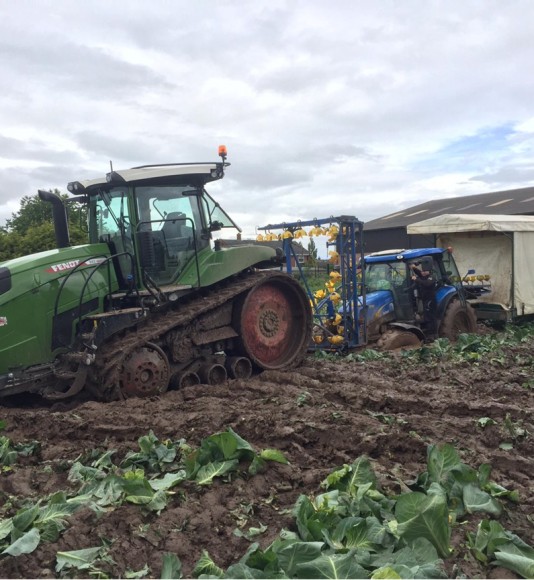
“Spring greens are also starting to suffer now,” he added. “There’s so much water in the soil that the leaves are just turning yellow and falling off.” As well as leading to crop losses and quality issues, the floods have been preventing growers from getting out into the fields to harvest the crop, or at least making it very difficult. “With all the incessant rain, it’s difficult to travel across the fields to harvest because the tractors and rigs and everything, especially in Lincolnshire, are just sinking out of sight,” said Simmons. “When you do manage to pull the tractors through the water with other tractors you damage so much of the crop. So, as well as not physically being able to harvest sometimes, a lot of crops are being damaged when you do.”

Simmons estimates that cauliflower volumes are currently about 25 per cent down on normal levels, forcing suppliers to import from France, Spain and the Netherlands. The problem is that growers in continental Europe have also been affected by wet, cold weather and it has been impossible to import enough product, causing shortages on shelf.

For example, the UK is struggling to import enough broccoli from Spain – the UK’s dominant import market for the product at this time of year – following floods and cold weather in south-eastern Spain towards the end of September. “We’re short on cauliflower and broccoli on the shelves,” he said. “Spring greens are the next brassica that could be very tight, and pointed, Sweetheart and Tenderheart cabbage are starting to tighten up as well now.”

For the time being, savoy, white and red cabbage remain unaffected, but Simmons foresees potential shortages at the end of the season in March/April. “They’re all planted at the same time for the winter period,” the Cornwall grower explained. “You grow over a big area and keep going over them through the winter, so if the crop is being damaged now during harvesting, supply probably won’t be affected until the end of the season.”

When it comes to Christmas supply, he said “it’s going to be tight” and crops “aren’t going to recover very quickly”, but it’s still too early to say how supply will be affected over the festive period.

He explained that Lincolnshire has been particularly hard hit because of how flat the terrain is. “Because it’s so flat up there the water can’t get away, and a lot of the rain they’ve had in Yorkshire and on the eastern side of the country comes down on the river which goes right through Boston. You can’t drain the water off the fields into the river because it’s full.”

Going forward, the unnamed grower previously quoted believes customers need to appreciate the weather is “doing some unusual things that will impact on availability week in week out for as long as we can probably foresee”.

He stressed that the answer isn’t simply to switch supply to another country because there’s been devastation across Europe throughout the summer.  “It’s a global issue rather than a local issue,” he said. “There’s obviously some change to the climate – what the root cause of that change is I’ll leave to the scientists to procrastinate about.”

By Fruit Net

Mexico, The World’s Third Largest Exporter of Strawberries

Mexico is one of the largest exporters of strawberries globally. In 2018, Spain, the United States, and Mexico led exports of this fruit, followed by the Netherlands, Belgium, Egypt, Morocco, South Korea, Germany, and Greece.

Strawberry crops adapt very well to many types of climates, despite them being very demanding in terms of soil conditions and reacting quickly to any biotic or abiotic stress, which leads to a significant decrease in their commercial performance.

In Mexico, the Ministry of Agriculture recommended producers, packers, and exporters to invest in the maintenance and improvement of plant health. They also suggest producers start negotiations with other countries to obtain the phytosanitary requirements for export and thus achieve diversifying exports.

The Ministry also recommends promoting intellectual property protection schemes – such as geographical recognition of origin and collective or certification marks – that allow positioning high-quality strawberries in markets with greater purchasing power, as well as allocating more strawberry to Mexico’s agribusiness.

Another suggestion is strengthening a position to avoid the implementation of non-tariff measures that would restrict Mexican strawberry trade in export markets. To achieve this, the Ministry of Economy and the Permanent Mission of Mexico at the WTO need to monitor the sanitary and phytosanitary measures (see equivalence) and technical barriers to trade (see labeled labeling) that members notify the WTO.

Due to the type of technology being applied to the crop (such as the use of cover and irrigation), it is best to do it in lines of 70 to 80 cm wide and 20 cm high. Two rows of plants, 40 cm apart from each other, are placed at a depth where the root neck is at ground level so that the roots are not exposed or the crown buried.

By Fresh Plaza

Singapore Traders Claim New Export Rules Raise Costs by 700%

Fruit and vegetable exporters for the Singapore market claim their operation costs have increased 700% since the Malaysian Quarantine and Inspection Service (Maqis) implemented new measures.

As explained on themalaysianinsight.com, on October 23, Maqis said the number of items that can be exported in one batch would be reduced to 10 from 50 previously. Industry players said this drove export costs up by between 500% and 700%, causing much unhappiness.

By Fresh Plaza

Chile’s Fresh Apple, Table Grape and Pear Supplies to Drop Over 2019/2020

In marketing year 2019/20, Chile’s fresh apple, table grape, and pear supplies will drop due to drought and a decline in planted area. Fresh apple exports will reach 656,650 tons in 2019/20, a seven percent decrease over 2017/18. Table grape exports will equal 640,000 tons, a three percent decrease over 2017/18, and fresh pear exports will decrease by 10 percent and total 117,000 tons. The United States remains the top market for Chile’s table grapes accounting for 45 percent of total Chilean table grape exports in 2018/19.

Trade
In 2018/19, Chile’s fresh apple exports decreased by 10 percent in volume and 8.4 percent in value over 2017/18 totaling 618,324 tons and $557 million respectively (data until August). Chilean apple exports are diversified and reach markets in North America, Latin America, Europe and the Far East. 2018/19 data ranked the United States as the top market for Chilean apples followed by Colombia, India and Taiwan. In 2018/19, Chilean fresh apple exports to the United States increased by 26.21 percent over 2017/18.

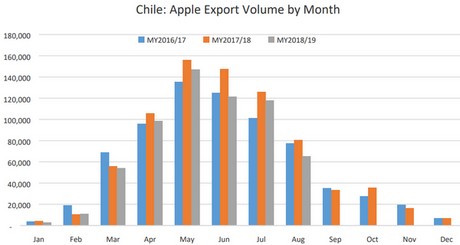
Apple exports to China, Taiwan, India, and Vietnam are expected to increase in the following marketing years as exporters focus their efforts on these Eastern markets seeking for high prices. Monthly export data shows a decrease in exports in 2018/19 during Chile’s peak export season, which ranges from March to August (See Graph). In 2018/19, post projects a 9.5 percent decrease over 2017/19 fresh apple exports, totalling 705,000 tons. For 2019/20, Post estimates a seven percent decrease in apple exports over 2018/19, totaling 656,650 tons.

Click here for the full report.

By Fresh Plaza

LGMA: Farmers Devastated by Latest Romaine Outbreak, Urge Consumers to Purchase Products Identified as Safe

Today’s announcement by the U.S. Food and Drug Administration (FDA) and the Centers for Disease Control (CDC) of expanding illnesses in the E. Coli O157:H7 outbreak associated with romaine lettuce is being met with frustration and heartbreak by California lettuce farmers.

“No one is more frustrated than the producers of leafy greens that outbreaks continue to be associated with our products,” said Scott Horsfall, CEO of the California Leafy Greens Marketing Agreement (LGMA).

The root cause of this and other recent outbreaks linked to romaine lettuce remain a mystery despite a concentrated focus on safety by leafy greens producers and government regulators.

“No one is more frustrated than the producers of leafy greens that outbreaks continue to be associated with our products,” said Scott Horsfall, CEO of the California Leafy Greens Marketing Agreement (LGMA), a food safety program created in 2007 to prevent foodborne illnesses caused by lettuce and leafy greens.

“We are devastated as a leafy greens community when this happens,” said Dan Sutton, a farmer from Oceano, CA. “Our thoughts go to those affected by this outbreak. But that’s why we want to continue to work with governmental agencies to learn why this is happening so that we can improve.”

According to FDA and CDC, consumers are advised not to eat any of the specific products included in recent salad mix recalls and to avoid romaine lettuce from Salinas. At this time, romaine lettuce that was harvested outside of the Salinas region has not been implicated in this outbreak investigation.

“Right now, romaine is being harvested in Arizona and southern California growing areas that are not part of this outbreak and harvest is nearly complete in the Salinas Valley,” explained Horsfall. “Public health agencies have stated that only product from the Salinas area is included in the consumer advisory. Romaine producers will be working closely with their customers to make sure all product from Salinas is removed from marketing channels, but romaine from any other growing area is safe for consumption.”

This means that romaine from the following regions is safe: Yuma, Phoenix, Southern Arizona, Northern Arizona, Northern California, Santa Maria, Southern California, Imperial Valley, Coachella and Central Valley. Product from Mexico and other states is also cleared. Hydroponically and greenhouse grown romaine is also not implicated in the outbreak.

“For the past year, producers have been voluntarily labeling romaine lettuce with information on harvest date and growing region,” explained Horsfall. “Today, this information provides consumers, retailers and foodservice operators with assurances the products they are purchasing have been identified as safe for consumption. We are hopeful these actions by industry will minimize withdrawal of safe product from stores and restaurants and reduce food waste.”

The current outbreak is occurring at a time when the production of leafy greens in central California is transitioning to growing regions in southern California and Arizona. It appears that romaine lettuce involved in this outbreak was likely harvested in the Salinas Valley growing area in September and October.

“We are very hopeful that what we learn from these recent outbreaks will help us to strengthen our food safety practices,” said Horsfall, who emphasized that since an outbreak linked to romaine last Thanksgiving, California and Arizona leafy greens producers made several changes to the food safety practices required of farmers. The changes include updated protocols for irrigation and increased buffer zones between leafy greens farms and adjacent animal operations.

A very stringent set of food safety practices is enforced on leafy greens farms through the LGMA system. Horsfall explained that the role of the LGMA is to verify through government inspection that leafy greens producers are following a set of food safety practices on the farm. Each LGMA member is subject to 4 to 5 on-farm audits each year that are conducted by government officials. The LGMA is the most comprehensive food safety program for fresh produce in the world.

“As farmers, we never want outbreaks to happen,” stressed Sutton, who serves as the chairman of the LGMA. “We will continue to do everything we possibly can to improve our required practices, to improve the way we farm leafy greens and to make sure we can improve the safety of these products we are putting out to our consumers.

“The situation is heartbreaking,” continued Sutton. “I have a very young family and the products we grow go to my family’s dinner table. My children consume the very same products we are sending out to consumers across the nation. That’s something I think about every day.”

The LGMA is working closely with public health agencies and have volunteered to assist with investigations in any way possible. The organization is also working with other initiatives to conduct research to learn more about how romaine is the source of outbreaks. They invite the public, media and government officials to learn more about their program and the practices required of leafy green producers at www.lgma.ca.gov or by contacting them directly at (916) 441-1240.

By Produce Blue Book

Church Brothers Farms’ Jason Lathos Discusses Transitioning Lettuce Crops

SALINAS, CA – When you hear Mother Nature knocking at your door, you better answer quickly, because she’s a lady you don’t want to keep waiting. Weather changes can happen at the drop of a hat, and while growers need to duck and weave the whole year ‘round, transitioning crops to new regions can be especially tricky. Like many growers, Church Brothers Farms is transitioning out of Salinas, California, to Yuma, Arizona, and like many, the weather has been a major factor in timing and supply.

Jason Lathos, Manager of Commodities, Church Brothers Farms

Jason Lathos, Manager of Commodities, Church Brothers Farms

“We’re not playing in a dome, we’re playing with Mother Nature,” Jason Lathos, Manager of Commodities, told me. “Mother Nature is our opponent—we’re playing in an outdoor arena. Weather has been a factor for the last four lettuce markets in the last year, and that’s exactly what’s happening now.”

Church Brothers Farms has seen a gap in its transition between growing areas, where one area finishes early, and another finishes late, which Jason says comes as no surprise, given the mercurial weather this season. The Salinas Valley saw a wave of abnormally warm weather, resulting in an early finish to the grower’s Salinas crop. At the same time, in Yuma two significant storms swept the region, bringing cold weather and unfavorable conditions with them, including rain, hail, and lightning.

Church Brothers Farms is transitioning out of Salinas, California, to Yuma, Arizona, and like many, the weather has been a major factor in timing and supply

Church Brothers Farms had intended to start at the end of October, but that start got pushed back two weeks. Contending with the weather can require some predictive thinking, and with the Salinas crop finishing early, and the Yuma crop starting late, choosing the right varieties is key.

“Iceberg lettuce is basically a three-month crop, and you’re planning the varieties based off of normal weather patterns,” Jason explained. “So, if you had a cold-weather variety planted, but when you’re getting close to harvest it’s hot, you have the wrong variety. Mother Nature is always the key. You never know what those crops are going to do.”

Church Brothers Farms has seen a gap in its transition between growing areas, where one area finishes early, and another finishes late

Church Brothers Farms is transitioning out of Salinas, California, to Yuma, Arizona, and like many, the weather has been a major factor in timing and supply

Consumer buying trends are another thing that can wax and wane with changing temperatures, according to Jason, so buyers can expect to see a decrease in short-term demand as 70 percent of the U.S. experiences temperatures of 32 degrees or lower. Keeping one eye on the sky and the other on the market is critical for balancing growing capabilities with demand for products.

“You try to connect all the dots, and the next thing you know, you were right or you were wrong,” Jason commented. “But for the short term, it’s been very active. For the long term, to be determined. Keep an eye on Mother Nature.”

By AndNowUKnow

As Romaine Problems Continue, FDA Takes Closer Look

The Food and Drug Administration will be collecting romaine samples in California and Arizona for a year to test for salmonella and E. coli following several foodborne outbreaks linked to the lettuce.

The new program begins this month, according to the FDA, citing two E. coli outbreaks in 2018 linked to romaine, and another one in October that was suspected to be from the leafy green. In its notice on the surveillance program, the FDA also cited a 2012 Salmonella Newport outbreak from romaine.

“Consistent with the FDA’s mission to protect consumers, if one of the target pathogens is detected as a result of this assignment, the agency will perform whole genome sequencing of the microorganism’s DNA to determine its virulence and whether it is genetically related to isolates causing human illness,” according to the notice.

All samples will be tested before processing to allow the FDA to quickly find the point of origin, which has been problematic in recent outbreaks as public and federal health agencies traced lettuce through the supply chain. In part, traceability hurdles have led to the FDA’s New Era of Smarter Food Safety program, which tasks the industry with enhancing traceability methods and technology.

Trimmed and washed lettuce will be tested, but not fresh-cut lettuce, and no lettuce at the farm-level will be involved in the surveillance program.

Samples will be targeted at facilities and farms identified in the outbreaks starting in 2017, including wholesalers, foodservice distribution centers, and commercial cooling and cold storage facilities, according to the FDA notice.

Sampling will increase in March/April and October/November, when the crop transitions from Yuma, Ariz./California’s Imperial Valley to Salinas, Calif., and the state’s Central Coast and Central Valley areas, and then back again for winter production. That’s the timeframe when many foodborne illness events linked to the crop happen.

The program’s sample size, 270, is relatively small. Each sample will consist of 10 sub-samples, increases the odds of finding pathogens if they’re present. If just one sub-sample is positive for a pathogen, the FDA reports it will consider all samples as positive for the organism.

If E. coli or salmonella are detected and confirmed, the FDA “will work with the firm to take appropriate action to protect the public health,” according to the notice, but seeks an approach of “educate before and while we regulate.” The FDA will follow up with the grower and “may consider multiple compliance and enforcement actions based on the available evidence and the adequacy of the firm’s response to prevent future contamination.”

The industry’s Romaine Task Force, formed after an E. coli outbreak last year that resulted in the FDA calling for the withdrawal of all romaine products days before Thanksgiving, recently released its final report. A web seminar on the task force’s findings and plan to address issues, is now on the Produce Marketing Association’s website.

By The Packer

Ocean Vessel Fuel Prices Rising for Produce Suppliers

Ocean transportation costs are going up, and that will translate to slightly higher delivered costs for Latin American produce hitting U.S. shores.

The allowed sulfur content of fuel used for international shipping is changing Jan. 1. By that date, the United Nations International Maritime Organization is requiring sulfur content in the fuel used for international shipping must be limited to 0.5%, down from the current standard of 3.5%. Costs for the new fuel are running nearly twice as high as the old standard and availability is tight as the shipping industry makes the transition.

That low-sulfur fuel regulation will apply to ocean-going shipments of all goods, including fresh produce. 

For banana powerhouse Chiquita, the new regulation is already impacting costs, said Carlos Lopez Flores, president of Chiquita, Fort Lauderdale, Fla.

It is a little like taking your car to the filling station and expecting to pay for regular gas but only the premium grade is available, Flores said.

“At the end of day it is a regulation we need to follow and we want to follow,” Flores said. “It is better for the environment and the sustainability of the world industry.”

Filling up

Chiquita has twelve of its own ships to transport bananas, with seven serving North America and five serving northern European markets. The first of Chiquita’s ships was filled with the low-sulfur fuel on Nov. 7. 

With increasing demand for low-sulfur fuel from all quarters, prices have been nearly double the previous standard fuel cost. Flores said prices for the low-sulfur fuel were ranging from $500 to $600 per ton compared with $350 per ton for the older fuel.

The cost of transportation as a percent of total costs depends on the market, accounting for perhaps 30% to 50% of costs for bananas shipped to Europe and 20% of costs for fruit shipped to North America, Flores said.

The main priority for Chiquita, he said,  is to make sure the company is able to secure fuel supply, so ships and shipments of fruit will not be delayed.

“You need to make sure you have a contract, make sure you have availability of the fuel, or otherwise you are going to be stuck (at the port) and there will be a delay in the trade,” he said. “It is all those question marks we are trying to manage right now.”

While the possibility for supply disruptions exists, Flores expects Chiquita and the entire banana trade to meet the challenge.

“I don’t foresee any major disruptions because of the lack of fuel to move the ships at this point,” he said.

While ships can burn alternative fuel such as natural gas or be installed with scrubbers to clean emissions, those options are mid-term to long-term in nature, Flores said.

Passing on the costs to customers is done by way of a fuel surcharge, Flores said.

For banana shipments to Europe, banana marketers have instituted a variable bunker (fuel) surcharge, which will go up and down according to the price of fuel.  The U.S. already had a fuel surcharge in place, and what surcharge will have a higher reference price reflecting the higher cost of fuel.

Cost pressures

At perhaps less than 1%, the impact on the price of bananas on the retail shelf will be small, he said. For example, banana prices could increase from 65 cents to 66 cents per pound at retail, he said. 

“The banana is still one of the cheapest fruits on the shelf,” he said. 

But cost pressures are on the upswing for banana producers, Flores said.

The last 30 years has seen the banana exist in an era of declining prices relative to other consumer goods.

That era is likely coming to an end, he said.

“(Cost) pressures are in every direction now,” he said. Inflation in labor, inflation in materials and now new regulations in fuel will increase costs. 

“We buy around 200,000 tons of fuel every year, so you can see we’re highly exposed to those types of cost increases,” he said.

Higher fuel costs will make the next year challenging.

“It will be a little bit of a bumpy ride for the next six to twelve months, but Chiquita bananas will continue to be grown, continued to be shipped and continue to be available,”  he said. 

By The Packer

close
Loading…